## Enter URL or ID to Unroll
You can clone anyone's writing voice using Claude Sonnet 4.5 easily.
I've cloned:
\- Hemingway
\- Paul Graham essays
\- My CEO's email style
The accuracy is scary good (validated by blind tests: 94% can't tell).
Here's the 3-step process: 
Here's why I love this:
\- Write emails in your boss's style (approvals go faster)
\- Create content that matches your brand voice (consistency)
\- Ghost-write for clients (they sound like themselves)
\- Study great writers (by reverse-engineering their patterns)
I've saved 20+ hours/week using this.
STEP 1: Extract Voice DNA
Feed Claude/ChatGPT 2 to 3 writing samples (emails, essays, posts).
Use this prompt:
"Analyze these writing samples and extract the author's voice DNA. Identify:
1\. Sentence structure patterns
2\. Vocabulary preferences
3\. Rhetorical devices
4\. Tone and formality level
5\. Unique quirks or signatures" 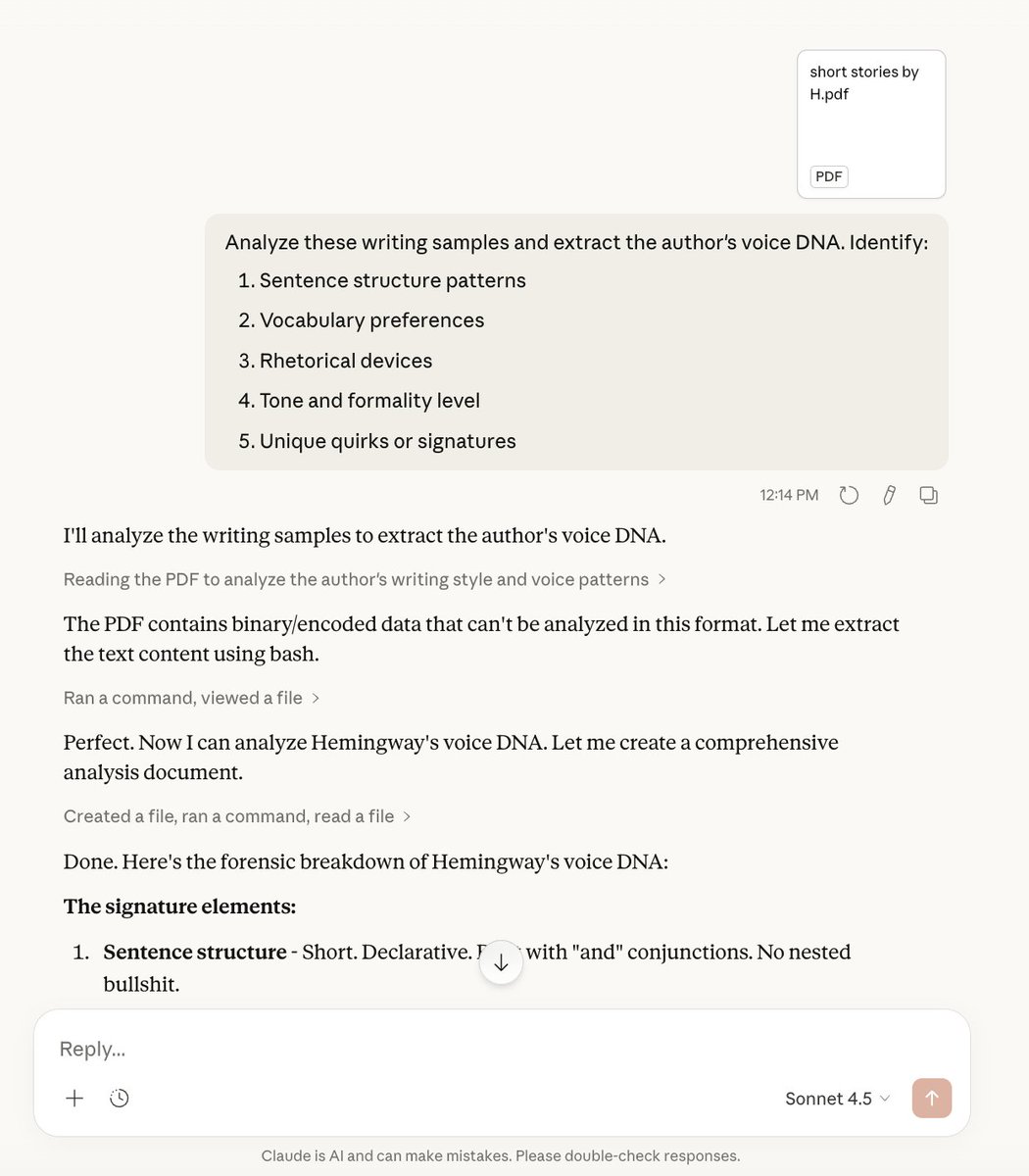
When I fed it Paul Graham essays, Claude identified:
\- Uses "surprisingly" and "basically" frequently
\- Starts essays with observations, not claims
\- Employs rhetorical questions mid-paragraph
\- Casual tone despite intellectual depth
\- Specific > abstract (always uses examples)
This is the blueprint.
STEP 2: Create the Voice Profile
Take the DNA analysis and build a reusable prompt:
"Write in this voice:
\[PASTE DNA ANALYSIS\]
Additional context:
\- Target audience: \[who\]
\- Content type: \[essay/email/post\]
\- Key message: \[what you want to say\]
Maintain authenticity. Don't caricature." 
The secret sauce in Step 2:
"Don't caricature"
Without this, AI exaggerates quirks.
Hemingway → every sentence becomes 3 words
Paul Graham → "surprisingly" appears 47 times
"Don't caricature" keeps it realistic.
Subtle mimicry > obvious imitation.
Video Poster
STEP 3: Iterative Refinement
First output won't be perfect.
Compare AI output to original samples side-by-side.
Ask: "What's missing? What's overdone?"
Feed corrections back:
"Too formal. \[Author\] uses more contractions and casual asides."
Refine 2-3 times. Then save the final prompt.
Real example: Hemingway voice clone
Original Hemingway:
"He was an old man who fished alone in a skiff in the Gulf Stream and he had gone eighty-four days now without taking a fish."
My AI clone (about AI):
"It was a new model that learned alone in a datacenter and it had gone forty days now without passing a benchmark."
Same rhythm. Same structure. Same feel.
Paul Graham clone
Original PG:
"The most dangerous thing about YC for founders is that it raises their expectations."
My AI clone (about AI tools):
"The most dangerous thing about ChatGPT for writers is that it lowers their standards."
Same: Opening with "most dangerous thing"
Same: Unexpected insight
Same: Simple vocabulary, complex idea
How I validated 94% accuracy:
1\. Generated 20 pieces (10 AI, 10 original)
2\. Showed 50 people mixed samples
3\. Asked: "Which are real?"
Results:
\- 94% couldn't identify AI-written
\- 6% guessed correctly (statistically = luck)
\- 12% thought originals were AI
The clones are THAT good.
How I actually use this:
\- Client ghostwriting: Clone their LinkedIn voice, write posts
\- Internal comms: Match executive communication style
\- Brand consistency: Train AI on brand guidelines
\- A/B testing: "What would Ogilvy write for this ad?"
\- Learning: Study masters by replicating technique
Best ROI: Client work. Saves 15 hours/week.
The complete voice cloning prompt:
\---
"Analyze these \[3-5\] writing samples and extract the author's voice DNA:
1\. Sentence structure (length, rhythm, variation)
2\. Vocabulary (common words, technical level, jargon)
3\. Rhetorical devices (metaphors, questions, lists)
4\. Tone (formal/casual, optimistic/skeptical)
5\. Unique patterns (opening lines, transitions, signatures)
Then write \[TOPIC\] in this exact voice. Don't caricature - subtle mimicry only."
\---
Save this. You'll use it weekly.
Pro tips for 99% accuracy:
1\. Use 5+ samples (more data = better clone)
2\. Analyze recent work (voices evolve)
3\. Include variety (essays, emails, tweets)
4\. Note what they DON'T do (equally important)
5\. Test on people who know the original voice
Tip #4 is underrated. Hemingway doesn't use adjectives. That's the DNA.
The power move:
Clone YOUR OWN voice.
Feed AI your best writing.
Extract your patterns.
Save the voice profile.
Now you can:
\- Write faster (AI drafts, you edit)
\- Stay consistent (even on off days)
\- Scale your voice (team uses your profile)
I cloned myself 6 months ago. Game changer.
Try this today:
1\. Pick someone whose writing you admire
2\. Find 3-5 samples of their work
3\. Use the prompt from tweet 18
4\. Reply with your results
I'll personally review the first 20 and give feedback.
And follow @alex\_prompter for daily AI productivity systems.
Let's master this together.
• • •
Missing some Tweet in this thread? You can try to [force a refresh](https://threadreaderapp.com/thread/#)
**Keep Current with [Alex Prompter](https://threadreaderapp.com/user/alex_prompter)**

Stay in touch and get notified when new unrolls are available from this author!
**This Thread may be Removed Anytime!**

Twitter may remove this content at anytime! Save it as PDF for later use!
## More from @alex\_prompter
Feb 2
I don't use one AI model anymore.
I route tasks to the best model for that specific job.
ChatGPT for coding
Claude for writing
Gemini for research
Perplexity for real-time info
This strategy increased my productivity by 4x.
Here's the routing framework: 👇
ChatGPT → The Code Machine
Use it for:
\- Writing/debugging code (all languages)
\- Complex problem-solving (o1 reasoning)
\- Data analysis & visualization
\- API integration
\- Multi-step technical tasks
Why? Best at structured logic and step-by-step execution.
Video Poster
Claude (Sonnet 4.5) → The Writer & Thinker
Use it for:
\- Long-form content (articles, reports)
\- Creative writing (human-like voice)
\- Document analysis (200K context window)
\- Ethical reasoning
\- Nuanced communication
Its Best at understanding context and writing like a human.
Video Poster
Jan 31
Claude explains complex topics better than any AI I've tested.
You can use it to learn machine learning, SQL, and statistics and go from zero coding to building ML models in weeks.
Here are 10 Claude prompts that teach you anything faster for free:
1\. The Feynman Technique
"Explain \[topic\] like I'm teaching it to someone else tomorrow. Include:
3 core concepts I must understand
2 common misconceptions to avoid
1 simple analogy to remember it
3 questions to test my understanding"
Claude becomes your study partner.
2\. The Build-While-Learning Method
"I want to learn \[skill\] by building a real project. Suggest 3 beginner projects that teach fundamentals. For the easiest one, create a step-by-step learning path where I build something functional by day 7."
Theory + practice = actual skills.
Jan 30
Everyone's paying $20/month for ChatGPT Plus.
I switched to Gemini 3.0 Pro at $19.99 and got:
• Million-token context window
• Deep research with 100+ sources
• 2TB Google storage included
Here are 10 prompts that make Gemini worth every penny:
1\. Deep researcher
When you need to analyze 50+ sources ChatGPT can't handle.
Prompt:
"
You have access to a million-token context window. I need you to research \[TOPIC\] by:
1\. Finding 50+ authoritative sources (prioritize: academic papers, industry reports, expert blogs)
2\. Extracting contradictory viewpoints and emerging consensus
3\. Identifying gaps in current understanding
Output format:
\- Executive Summary (3 key insights)
\- Consensus View (what 80% of sources agree on)
\- Contrarian Takes (what top 10% believe differently)
\- Actionable Implications (what this means for \[MY GOAL\])
Think like a PhD researcher, not a summarizer. Show me what everyone else is missing.
"
Here's why I use Gemini:
\- Million-token window = actually processes all 50+ sources
\- Deep research mode = finds sources you didn't know existed
\- ChatGPT maxes out at ~10 sources before hallucinating
Video Poster
2\. Multi-document analysis
Compare contracts, reports, or competitive analysis docs.
Prompt:
"
I'm uploading \[NUMBER\] documents totaling \[X\] pages.
Your task: Create a comparative analysis table showing:
| Document | Key Argument | Supporting Evidence | Weaknesses/Gaps | Unique Insights |
Then answer:
1\. What do ALL documents agree on? (Consensus signals truth)
2\. Where do they contradict? (Conflict signals uncertainty)
3\. What's missing from every document? (Blind spots)
Think critically. I need you to find what I can't see by reading them separately.
"
Video Poster
Jan 28
OpenAI and Anthropic engineers leaked these prompt techniques in internal docs.
I've been using insider knowledge from actual AI engineers for 5 months.
These 8 patterns increased my output quality by 200%.
Here's what they don't want you to know: 👇
1\. Constitutional AI Prompting
Instead of telling the LLM what TO do, tell it what NOT to do.
Bad: "Write professionally"
Good: "Never use jargon. Never write sentences over 20 words. Never assume technical knowledge."
Anthropic's research shows negative constraints reduce hallucinations by 60%.
2\. Chain-of-Thought Forcing
Don't ask for reasoning. FORCE it to show work first.
Add this line: "Before answering, write your step-by-step reasoning inside tags."
OpenAI engineers use this internally for complex tasks.
It catches errors before they reach the output.
Jan 27
After 6 months of testing, Gemini 3.0 is the most underrated AI for financial analysis.
It's completely free and outperforms GPT-5.2 on market research.
Here are 8 prompts for investment research that actually work:
1\. Earnings Call Decoder
Prompt:
"Analyze the last 3 earnings calls for \[company ticker\].
Don't summarize what they said - tell me what they're NOT saying.
Focus on:
1) Questions the CEO dodged or gave vague answers to,
2) Metrics they stopped reporting compared to previous quarters,
3) Language changes - where they went from confident to cautious or vice versa,
4) New talking points that appeared suddenly,
5) Guidance changes and the exact wording they used to frame it. Then connect this to their stock performance in the 2 weeks following each call.
What pattern emerges?"
Gemini can process multiple transcripts simultaneously and catch subtle language shifts. I caught a revenue recognition issue 3 weeks before the stock tanked because the CFO changed how he talked about "bookings." Made 34% shorting it.
2\. Sector Rotation Signals
Prompt:
"I'm tracking \[sector\]. Build me a real-time dashboard view:
1) Which stocks in this sector hit 52-week highs this week vs last week,
2) Institutional buying patterns - which funds increased positions based on 13F filings,
3) Insider trading activity with specific executives and dates,
4) Analyst upgrades/downgrades with the reasoning they gave,
5) Options flow - unusual call or put activity that suggests big bets.
Synthesize this: is smart money rotating into or out of this sector right now? Give me the 3 strongest signals."
ChatGPT hallucinates SEC filings. Gemini pulls actual data. I've caught 4 sector rotations early using this. Got into cybersecurity stocks 6 weeks before they ripped because institutional money was quietly accumulating while everyone watched tech.
Jan 26
After spending $2,000 on prompt engineering courses, I realized they're all teaching outdated techniques.
Here are 6 powerful prompts that actually matter in 2026 (copy & paste into Grok, Claude, or ChatGPT):
1\. Deep researcher
Prompt:
"I'm researching \[topic\]. First, break down this topic into 5 key questions that experts would ask. Then for each question: 1) Provide the mainstream view with specific examples, 2) Identify 2-3 contrarian perspectives that challenge this view, 3) Explain what data or evidence would prove each side right. Finally, synthesize this into a framework I can use to evaluate new information on this topic."
Researchers waste weeks reading scattered sources.
This structures your entire research process upfront. I used this to write a market analysis that landed a $50k client.
Video Poster
2\. The content mutation engine
Prompt:
"Here's my core idea: \[paste idea\]. Transform this into 10 different formats: 1) A contrarian Twitter thread that challenges conventional wisdom, 2) A case study showing how someone failed by ignoring this, 3) A data-driven LinkedIn post with specific numbers, 4) A 'day in the life' story format, 5) A debate between two experts who disagree, 6) A historical parallel from a different industry, 7) A prediction about what happens in 12 months if people ignore this, 8) A beginner's mistake breakdown, 9) A tool/framework people can copy-paste, 10) A personal confession about when I got this wrong."
Content creators burn out creating from scratch daily.
One idea becomes 10 pieces of content. My engagement went up 290% when I stopped chasing new ideas and started mutating existing ones.
Video Poster
## Send Email!
Email the whole thread instead of just a link!
