# 13._Artifacts_in_Material_Beings_by_van_Ingwan
## Metadata
- Author: [[Peter van Inwagen]]
- Full Title: 13._Artifacts_in_Material_Beings_by_van_Ingwan
- Category: #articles
- Summary: insert summary
- My notes:
- Summary: Peter van Inwagen discusses the nature of artifacts, arguing that traditional views on objects like statues and clay lumps are flawed. He suggests that many artifacts do not truly exist, as they are merely arrangements of simpler objects. The debate about the identity of artifacts is complicated by the idea that their existence relies on the intentions and actions of agents.
- URL: https://readwise.io/reader/document_raw_content/224509238
- Source File: Metaphysics by Peter van Inwagen.pdf
## LLM Chats
## NotebookLM
## LLM Audio
## Highlights
> ts ([View Highlight](https://read.readwise.io/read/01j9rzrp9r8tznj48pwyksew0n))
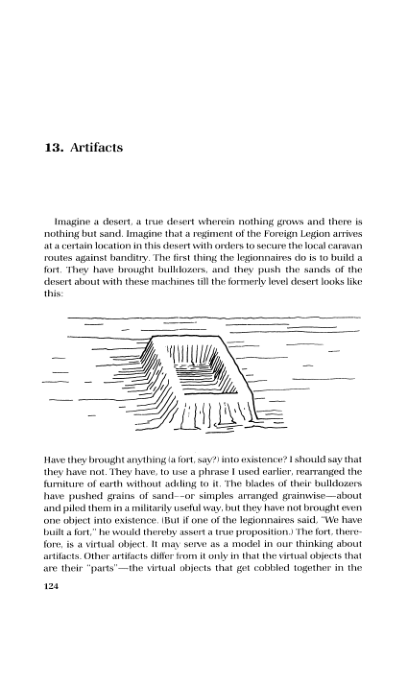
> Have they brought anything (a 1'ort, say?) into existence? 1 should say that they have noto ([View Highlight](https://read.readwise.io/read/01j9rzkj5xzy1x3gtc7w9bgf3s))
> The fort, there- fore, is a virtual object. It may serve as a model in our thinking about artifacts. ([View Highlight](https://read.readwise.io/read/01j9rzm59ybgka57r1czbdk5yf))
> Suppose that a sculptor comes upon a nondescript lump of clay and kneads it into the shape of aman. According to the philosophers 1 am thinking of, the sculptor thereby brings an object-a statue-into exis- tence. But (these philosophers say) the lump of clay continues in exis- tence. It occupies the same space as the statue and has the same shape and weight and color and texture, but it retains its separate identity. We must suppose this (these philosophers teIl us) because there is some- thing there that has properties that the statue does not have. These are, roughly, the properties that Descartes ascribed to his famous piece of wax. ([View Highlight](https://read.readwise.io/read/01j9rzsps1spepk03wt4yhcqfk))
> He will say (presumably) something like this: Lying in [he desert floor when the Legion arrived, mixed with many others of its kind, was a certain mass of sand¡ the bulldozers prodded this mass of sand till it was fort-shaped (separating it from the others of its kind in the process), thereby producing a new object, a fort, an object that differed from the now fort-shaped mass of sand in its modal and historical properties-but only in those. ([View Highlight](https://read.readwise.io/read/01j9rzybx3tsxjppeqrq61j9m7))
> J If you take this incredible view, then, I think, you should also take the view that whatever outré shape a lump of clay might have, that lump is spatially coincident with an object with which, though the two are distinct, it shares all its momental}' properties. Pick up a lump of clay and knead it into sorne complicated and arbitral}' shape. Call anything essentially of that shape a golIyswoggle. Did you bring a gollyswoggle into existence? 1 should think that if our sculptor brought a statue into existence, then you brought a gollyswoggle into existence. 'Statue- shaped' is a less definite shape predicate than 'gollyswoggle-shaped', and one we have a use for, and our sculptor intended to produce something statue-shaped while you, presumably, did not intend to pro- duce anything gollyswoggle-shaped. ([View Highlight](https://read.readwise.io/read/01j9s02acnwp292s46g73skq60))
> But these facts would seem to be irrelevant to any questions about the existence of the thing produced¡ if you can make a statue on purpose by kneading clay, then you can make a gollyswoggle by accident by kneading clay. But if you can make a golly- swoggle by accident by kneading clay, then you must, as you idly work the clay in your fingers, be causing the generation and corruption of the members of a compact series of objects of infinitesimal duration. That is what seems to me to be incredible. ([View Highlight](https://read.readwise.io/read/01j9s03cvrwvr60ymsz81h10kk))
> If we imagine our snake to be an intelligent being and imagine him to reflect on the question 'Is there an object-a hammock-that is numerically distinct from me but currently spatially coincident with me?' then we do a grave disseIVÍce to the intellectual reputation of our helpless creature offiction ifwe make him answer this question in the affirmative. A really intelligent intelligent snake in the curious circumstances we have imagined will conclude, afier only a vel)' brief moment of reflection, "No, no ... there's nothing here but me." Ifwe, too, are intelligent, we shall agree with him.45 But if we do agree that the snake momentarily becomes a hammock, then, surely, we should also agree (if we believe in any of these things at al!) that the lump of clay momentarily becomes a statue and the mass of sand momentarily becomes a fort. ([View Highlight](https://read.readwise.io/read/01j9s06j1r0c7cf0y8f7356pef))
> There are, therefore, no tables and chairs, and there are no other artifacts-with the unlikely exception of a few things like our living hammock. Artisans do not create; not, at least, in the sense of causing things to existo They rearrange objects in space and cause bonding relations to begin to hold or to cease to hold (as in the case of the sculptor who chips away at a block of marbleJ between objects. But, in the last analysis, the labors of Michelangelo and the most skilled watch- maker are as devoid of true metaphysical issue as the labors of our legionnaires. AlI these people are simply shoving the stuff of the world about. ( ([View Highlight](https://read.readwise.io/read/01j9s08vt55fcdwmpzr6jevj11))
> The answer to the Special Composition Question 1 have proposed has, of course, a short waywith this puzzle: There are no ships, and hence there are no puzzles about the identlities of ships. But, although this much is quite true, it can be elaborated. Let us tell the story ofthe Ship ofTheseus in language that does not make even apparent reference to ships. (To simplifY this project, let us suppose that those virtual objects called 'ships' are composed entirely ofsimples called 'planks'. Or, ifyou like, we could say that in telling our story, we are treating the planks as "honor- ary simples," since their individual identities are not in question and since their virtual parts and relevant virtual causal properties are invarí- ant throughout the story. This is a useful device that allows us to use homely words like 'plank' and tberefore allows us to tell our story with a mínimum of stage-settíng. But íf anyone insísts on it, we can replace our talk of planks with of simples arranged plankwise.l ([View Highlight](https://read.readwise.io/read/01j9s0dmsq75p44352sxpdmz8t))
> "But we do, in the ordinary business of life, utter identity sentences that refer to artifacts. And, in uttering these sentences, we sometimes say things that are true and sometimes say things that are falseo If we say, 'This is the house that Jack builí' and it is the house that Jack bullt, then we're right, and if it's the house that Jill bullt, then we're wrong. How would you account for this difference?" ([View Highlight](https://read.readwise.io/read/01j9s0ggrftaenv1c3zhwqxp00))
> . I would add that 1 don't think that the Martians' language is superior to ours. It may be that theirs "more adequately reveals the structure ofthe world," in the sense that it lacks certain features that are ([View Highlight](https://read.readwise.io/read/01j9s0ppbgk6xmg8na4bbfehxs))
> likely to mislead philosophers who are attempting to describe the struc- ture of the world and who are, consciously or unconsciously, guided in these attempts by the structure of the language they use to talk about the world. ([View Highlight](https://read.readwise.io/read/01j9s0pwr9m30dqvgde44cymvx))
> Paraphrasis like our retelling ofthe stmy ofthe Ship ofTheseus or our earlier reparsing of 'Sorne chairs are heavier than sorne tables' is of philosophical interest mainly because it provides us with altematives to our ordinary idioms, altenlatives that may be pressed into service when philosophers subject those idioms to dialectical pressures they were not designed to withstand. Consider a simple identity problem about houses. The Wise Pig built a house entirely of bricks (honorary simplesJ, ten thousand ofthem. That was three generations ago. Overthe years his industrious descendants have replaced two thousand of these bricks. Assuming that there is such a thing as the house the Wise Pig built and that there is a house here now, then either the house here now is the house the Wise Pig built or it isn't or the Law of the Excluded Middle requires sorne sort of amendment.46 If you think that there are, in the stric!, philosophical sense, houses-if you think that when bricks are arranged housewise, they compase something-thenyou are faced with the problem of choosing one (lf these altematives. ([View Highlight](https://read.readwise.io/read/01j9s0vwe0568g9rq6rgj9ffvd))