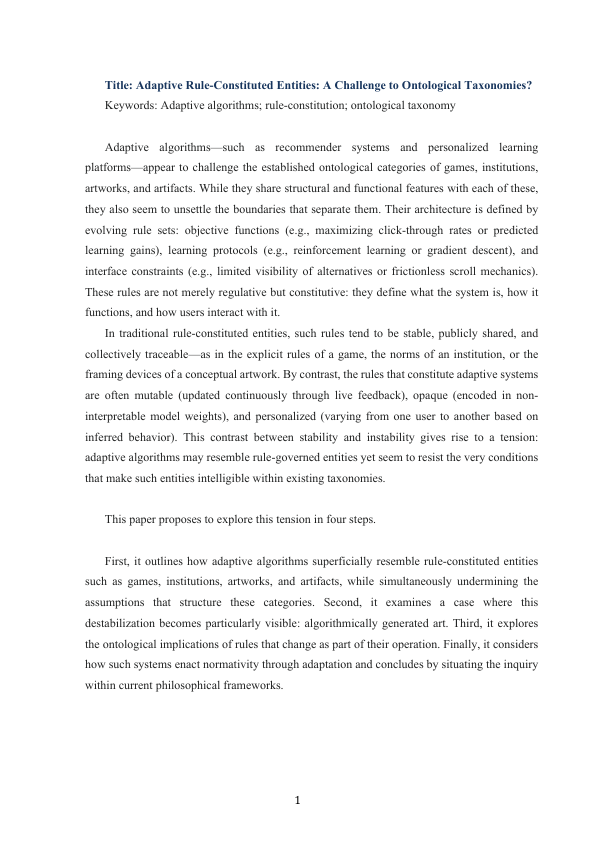
# Adaptive Rule-Constituted Entities: A Challenge to Ontological Taxonomies?
## Metadata
- Author: [[Unknown]]
- Full Title: Adaptive Rule-Constituted Entities: A Challenge to Ontological Taxonomies?
- Category: #articles
- Summary: insert summary
- My notes:
- URL: https://readwise.io/reader/document_raw_content/360551250
## LLM Chats
## NotebookLM
## LLM Audio
## Highlights
> These analogies, though instructive, prove fragile under scrutiny. The entities in question begin to appear as games without fixed goals, institutions without sanction, artworks without artists, and artifacts without stable identity. Their rule-constitution is not declared but emergent, not stable but dynamic. The more precisely we try to categorize them, the more they seem to deform the very taxonomies we rely on. ([View Highlight](https://read.readwise.io/read/01k4mj0bk3z17cn1fn6917gm6r))
- Note: i was with you up to here.
> 1. Disrupted Analogies: Games, Institutions, Artworks, Artifacts ([View Highlight](https://read.readwise.io/read/01k4mj4xgwg4jy8qg6jd8wmdrg))
- Note: this is cool
> At first glance, adaptive algorithms seem to fall comfortably within familiar types. Like games, platforms such as *Duolingo* rely on interactive feedback loops—but their goals can shift invisibly, without a declared endpoint. Like institutions, systems such as *LinkedIn* or *YouTube* assign roles and permissions—but without public procedures or normative sanction. Like artworks, interfaces like those of *Spotify* or *TikTok* organize affect and frame attention—yet without a discernible authorial intent. And like artifacts, recommender engines are designed to fulfill formal functions—yet the functions themselves evolve based on behavioral data. ([View Highlight](https://read.readwise.io/read/01k4mj4t99gtycxdxa105nh9rw))