# Demystifying Reasoning Models
## Metadata
- Author: [[Cameron R. Wolfe, Ph.D.]]
- Full Title: Demystifying Reasoning Models
- Category: #articles
- Summary: insert summary
- My notes:
- Summary: Reasoning models are a new type of large language model (LLM) that improve performance by focusing on detailed thought processes before giving answers. Recent advancements by OpenAI and others have shown how these models can solve complex tasks more accurately using reinforcement learning. This research opens the door for developing smaller, efficient models with strong reasoning abilities.
- URL: https://cameronrwolfe.substack.com/p/demystifying-reasoning-models?utm_source=share&utm_medium=android&r=62t39&triedRedirect=true
- Source File: web-only
## LLM Chats
## NotebookLM
## LLM Audio
## Highlights
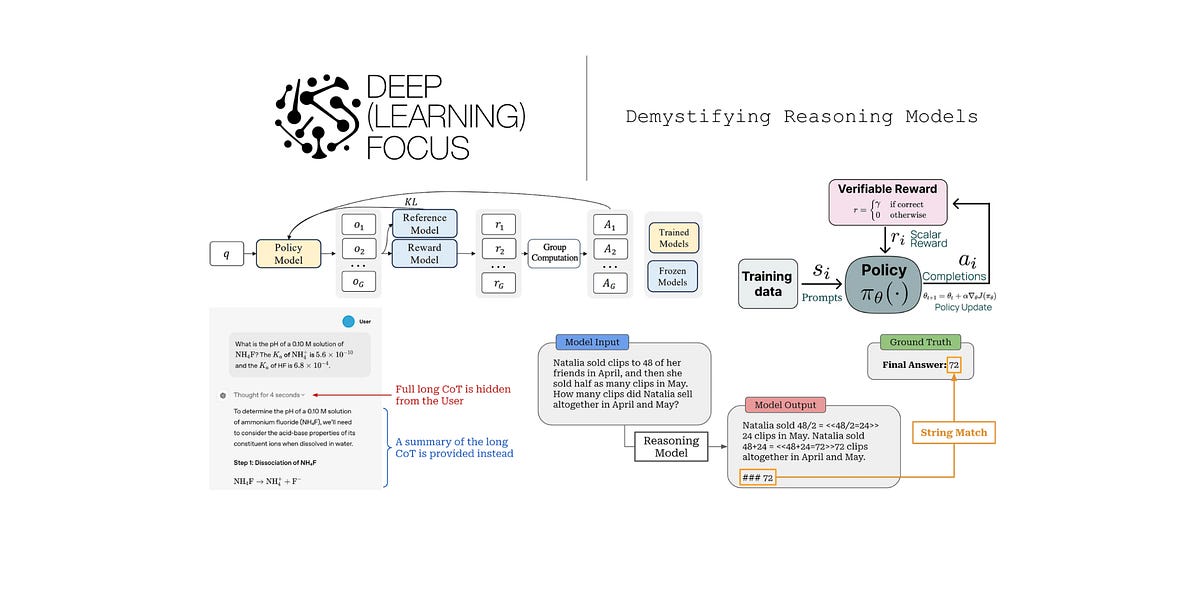
> One detail that we should immediately notice about o1-style models is that they are primarily used for and evaluated on problems that are verifiable in nature; e.g., math and coding. But, *what exactly does “verifiable” mean in this context?* First, we assume that we have access to either *i)* a ground truth answer for the problem or *ii)* some rules-based technique that can be used to verify correctness. ([View Highlight](https://read.readwise.io/read/01k5xn67hqjnpc3md5nrk7przb))
- Tags: [[generating philosophy paper]]
> Saying that a domain is “verifiable” does NOT mean that we can automatically verify arbitrary solutions to problems in this domain. Rather, we will often need access to ground truth answers—*typically obtained from humans*—for verification. ([View Highlight](https://read.readwise.io/read/01k5xn96apm6xpe6mxgmhhme9t))
- Tags: [[generating philosophy paper]]
> **Chain of thought.** We already know that reasoning models use long CoT as their medium for reasoning. Proposed in [8], a chain of thought—*at the simplest level*—is just an explanation that an LLM provides for its own output. In most cases, these explanations are written prior to the LLM generating its final answer, allowing the model to use its explanation as context when generating its answer; ([View Highlight](https://read.readwise.io/read/01k5xnsrhtp1skwbtyvqsjrxe8))
- Tags: [[generating philosophy paper]]
> The long CoT used by reasoning models is much different than a standard CoT. A standard CoT is concise and human-readable. A long CoT is several thousand tokens long[8](https://cameronrwolfe.substack.com/p/demystifying-reasoning-models?utm_source=share&utm_medium=android&r=62t39&triedRedirect=true&__readwiseLocation=#footnote-8-153722335). Although it can be used for interpretability purposes, the long CoT is not optimized for human readability. Rather, it is an extensive reasoning trace that approaches problem solving in a detailed manner and contains a variety of complex reasoning behaviors (e.g., backtracking and self-refinement). ([View Highlight](https://read.readwise.io/read/01k5xnxzhc8hg3jv2xv2ktbyx8))
> *“We have decided not to show the raw chains of thought to users… We strive to partially make up for [this decision] by teaching the model to reproduce useful ideas from the chain of thought in the answer. For the o1 model series we show a model-generated summary of the chain of thought.”* - from [5] ([View Highlight](https://read.readwise.io/read/01k5xny4ec8cnwxa6250zsn0fy))