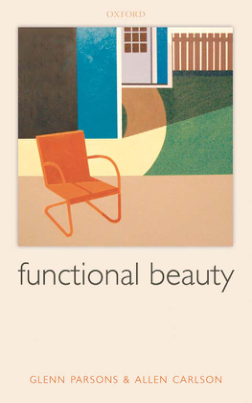
# Functional Beauty by Carlson and Parsons
## Metadata
- Author: [[readwise.io]]
- Full Title: Functional Beauty by Carlson and Parsons
- Category: #articles
- Summary: insert summary
- My notes:
- Summary: The book argues for the importance of understanding function in aesthetic appreciation, introducing the concept of 'Functional Beauty'. It explores how function influences aesthetics and addresses theoretical issues. The text discusses the relationship between function and beauty, examines the aesthetics of everyday objects, and highlights the role of Functional Beauty in various aspects of aesthetic experience, including art and nature.
- URL: https://readwise.io/reader/document_raw_content/143168204
- Source File: Functional beauty by parsons and Carlson.pdf
## LLM Chats
## NotebookLM
## LLM Audio
## Highlights
> We could also say, a little more grandly, that a complete solution requires a phenomenology of Functional Beauty: an account of the way in which function ‘shows up’ not just in what we experience perceptually, but in the aesthetic qualities that we experience perceptually. ([View Highlight](https://read.readwise.io/read/01hq00s3j8efvfna9yn1rhwdyz))
> George Dickie further questions the legitimacy of basing a species of beauty on notions related to fitness, remarking: ‘The simple fact is ... that no one, except an occasional philosopher, has ever claimed that utility is a kind of beauty.’ ([View Highlight](https://read.readwise.io/read/01hq00wnhtt7rxf2f8hpr0k8q2))
> In favour ofthis view, it can be noted that, often, the pleasures that we take in things that look fit involve the satisfaction of certain of our desires. Part ofwhat Jones might find pleasing in his fit-looking muscle car, for example, is the fact that it satisfies his desire to drive fast, or to impress women at the beach. Expanding on this point, one might suggest that, in fact, it is this sort of satisfaction that ultimately accounts for all of the pleasure that we take in observing things that are fit for their function. The fit look itself may only serve to signal a thing’s capacity to satisfy certain desires, thereby engendering our pleasure in the satisfaction, or potential ([View Highlight](https://read.readwise.io/read/01hq00yepywsyqjf8traqg4hh8))
> satisfaction, ofthose desires. Jones may find the sight of his muscle car pleasing, for example, not because of the fit look per se, but simply because that look signals that his desires to drive fast and to impress women at the beach will be fulfilled. ([View Highlight](https://read.readwise.io/read/01hq00yj0njtzg8vfa0d50kg65))
> However, the sceptical line of thought remains a potential threat to the idea that apparent fitness is a form of Functional Beauty. Can it be answered? The line of thought is based on two premises: first, the idea that aesthetic qualities are characterized by disinterestedness, in the sense of involving a pleasure taken in perceptual appearance for its own sake, and, second, the assumption that the ultimate source of all our pleasure in things that look fit is their utility in advancing human interests, rather than their appearance per se. ([View Highlight](https://read.readwise.io/read/01hq0154tjpp9gt0tpqrbz68vr))
> the ultimate source of all our pleasure in things that look fit is their utility in advancing human interests, rather than their appearance per se. ([View Highlight](https://read.readwise.io/read/01hq394gtfweerg6g73a0qnh5n))
> A watch ... that falls behind above two minutes in a day, is despised by one curious in watches. He sells it perhaps for a couple of guineas, and purchases another at fifty, which will not lose above a minute in a fortnight. The sole use of watches however, is to tell us what o’clock it is, and to hinder us from breaking any engagement, or suffering any other inconveniency by our ignorance in that particular point. But the person so nice with regard to this machine, will not always be found either more scrupulously punctual than other men, or more anxiously concerned upon any other account, to know precisely what time of day it is. What interests him is not so much the attainment of this piece of knowledge, as the perfection of the machine which serves to attain it.¹⁸ ([View Highlight](https://read.readwise.io/read/01hq0172ym5fk7yep7abze0war))
> The difference in precision between a thirty-dollar quartz watch and a thousand-dollar Swiss watch is to be measured in seconds per year or less, and as such confers no practical advantage whatsoever. Yet far greater pleasure is taken in the more finely wrought watch.¹⁹ ‘What pleases these lovers of toys,’ Smith writes, ‘is not so much the utility, as the aptness ofthe machines which are fitted to promote it.’²⁰ ([View Highlight](https://read.readwise.io/read/01hq018gbq93hmfs791n35fqp5))
> Smith’s line of thought demonstrates that the second premise underlying the sceptical take on the status of ‘looking fit’ as an aesthetic quality is false: it is not the case that the ultimate source of all our pleasure in things that look fit is their utility in advancing human interests, rather than their appearance per se. We may, of course, not derive this aesthetic pleasure when we contemplate a particular functional object, delighting instead in the gratification ofour desires that the object signals, just as the farmer, by delighting in the pecuniary rewards of his field, rather than the field itself, may fail to engage in aesthetic appreciation. We may each of us consult our own experience to determine the extent to which our delight in functional things is aesthetic. But the above example shows that, however much we actually exercise it, we do possess the capacity to take pleasure in the mere perception of a thing’s looking fit. As such, looking fit qualifies as an aesthetic quality. ([View Highlight](https://read.readwise.io/read/01hq01cnd16yk06j5ye531d4zt))
## New highlights added June 1, 2025 at 11:13 PM
> Despite a recent renaissance of philosophical writing on the beauty of nature, the aesthetic appreciation of living organisms remains a neglected topic. Sustained discussions are rare, and where we do find philosophers and other theorists taking up the topic, we discover a bewildering variety of approaches.¹ In this section, we will survey some of these. ([View Highlight](https://read.readwise.io/read/01jwntcg0m0naxn73m2qns2jdr))
> Despite a recent renaissance of philosophical writing on the beauty of nature, the aesthetic appreciation of living organisms remains a neglected topic. Sustained discussions are rare, and where we do find philosophers and other theorists taking up the topic, we discover a bewildering variety of approaches.¹ In this section, we will survey some of these. ([View Highlight](https://read.readwise.io/read/01jwntcg4794fph630n28yncaj))
> Despite a recent renaissance of philosophical writing on the beauty of nature, the aesthetic appreciation of living organisms remains a neglected topic. Sustained discussions are rare, and where we do find philosophers and other theorists taking up the topic, we discover a bewildering variety of approaches.¹ In this section, we will survey some of these. ([View Highlight](https://read.readwise.io/read/01jwntch1pzss9751kn741s24d))
> Despite a recent renaissance of philosophical writing on the beauty of nature, the aesthetic appreciation of living organisms remains a neglected topic. Sustained discussions are rare, and where we do find philosophers and other theorists taking up the topic, we discover a bewildering variety of approaches.¹ In this section, we will survey some of these. ([View Highlight](https://read.readwise.io/read/01jwntcjnx7d6c04sjhm7ffz5x))
## New highlights added October 15, 2025 at 3:46 PM
> This is not a matter of determining the function of an object, but rather of understanding how knowledge of that function can play a role in our perception of, and hence our aesthetic appreciation of, that object ([View Highlight](https://read.readwise.io/read/01k7kwaa63wfzz9g3dvzm6qssg))
> By employing a category in perceiving an artwork, then, we implicitly impose a kind of structure upon its various perceptual qualities. In other words, our knowledge of the kind of artwork we are viewing, by implicitly designating specific features as either standard, variable, or contra-standard, causes us to see a certain sort of order, or lack of order, in the overall array of non-aesthetic perceptual properties possessed by that object. This change in perception may then affect our perception of the object’s aesthetic qualities: by employing a certain artistic category in perceiving a work, we may come to perceive the work as having different aesthetic qualities from those it otherwise would. ([View Highlight](https://read.readwise.io/read/01k7kxf4d33x43g6tt10mf4dn1))