# Imagining Dinosaurs
## Metadata
- Author: [[OUP Academic]]
- Full Title: Imagining Dinosaurs
- Category: #articles
- Summary: insert summary
- My notes:
- Summary: Mounted dinosaur skeletons are created through significant imagination and artistic effort, making them potential artworks rather than just scientific specimens. Their assembly encourages audiences to engage their own imagination to visualize the living creatures. Despite concerns over accuracy, these mounts serve to inspire awe and curiosity about the past.
- URL: https://academic.oup.com/jaac/article/82/2/191/7630444
## LLM Chats
## NotebookLM
## LLM Audio
## Highlights
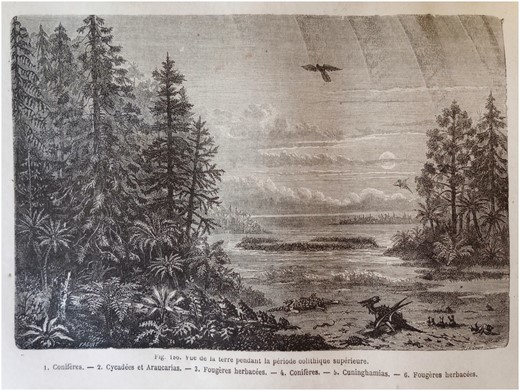
> This is an entirely unremarkable—and typically uninspired—piece of early paleoart, apart from one small detail: the *Archaeopteryx* is headless. This is not an obvious detail. The dinosaur is small, its features difficult to make out without additional magnification. Its wings and tail are clearly feathered, which is no surprise since it is renowned as the first feathered dinosaur to be discovered. A nub between its shoulders hints at a head, but Figuier’s text is unequivocal: “In the air flies the *bird of Solnhofen* (*Archaeopteryx*), which we have restored as it may have existed in life, save for its head, which was not found with the animal’s other remains” (1866, 228). ([View Highlight](https://read.readwise.io/read/01jhgc0ywhy5pxxb24bq3krw5s))
> *Archaeopteryx* aside, none of this should be very surprising. Lithography, after all, is a “manugraphic” art: it relies on someone drawing an image by hand, rather than on the “pencil of nature.” ([View Highlight](https://read.readwise.io/read/01jhgc3zb3rv2qrpg4tb9hkkny))
> Similarly, to say that something is *imagination*-dependent is to say that its existence depends on some agent’s act of imagination. We can distinguish two different ways in which this might be the case. On the one hand, an artifact or performance might be imagination-dependent insofar as bringing it into being required someone’s substantive act of imagination. This is the case with fictional characters, who owe their existence and attributes to their author’s acts of imagination, as codified in the text they produce. It is also often true of ordinary artifacts such as corkscrews, whose precise configuration derives from somebody’s inventiveness. In these cases, someone’s act of imagination is a crucial component part of the causal process that brings something about. The imagination involved in such exercises is commonly glossed as ‘creativity’; in the philosophical literature, it goes by the label of ‘creative imagination.’ It is the kind of imagination that is mobilized “when someone puts together ideas in a way that defies expectation or convention: the kind of imaginative ‘leap’ that leads to the creation of something valuable in art, science, or practical life” (Currie and Ravenscroft 2002, 9).4 ([View Highlight](https://read.readwise.io/read/01jhgchahrapxfjmm6ncegw82s))
- Tags: [[creativity]]
> When the Romantic period displaced Neoclassicism, so too did it replace verisimilitude and imitation as the standard of art. But, if anything, the imagination gained even more importance for those steeped in the Romantic ethos, according to whom artists have a special imaginative capacity (namely, “genius”), which the rest of us lack, and which gives them a special kind of insight into the world. Immanuel Kant, for one, argued that the artistic genius is someone gifted with superior powers of imagination and understanding (2000 [1790], §317). Building on Kant’s analysis of artistic genius, Arthur Schopenhauer was careful to distinguish the capacities for imagination and genius, arguing that the former is necessary for the latter since it enables the artist to see beyond the objects perception presents to them, and to the Platonic Ideas that animate them (1818, §36). Vestiges of the connection between creative genius and imagination still exist today, stripped of their connection to the problematically gendered notion of “genius.” Berys Gaut, for example, has argued that creativity is closely linked to imagination: imagination is the mental capacity upon which creativity is typically predicated (2003, 279). ([View Highlight](https://read.readwise.io/read/01jhgct09my26220c6ckyva5rh))
> Sartre, for example, argued that aesthetic experiences are “induced dreams” in which the work is an imaginative “analogue” of some concrete object or performance (1948, 27–30, 273–7, 281). So, for example, when we hear a musical work, we do not experience it as a real thing that is temporally-extended and exists in the external world, but rather our imagination grasps the performance as an analogue of the real work; as he puts it, “I do not hear it actually, I listen to it in the imaginary” (1948, 280). Each of us therefore experiences a slightly different work (1948, 275). Collingwood similarly thought that all artworks are “imaginary things” that exist in audience members’ minds. To gently paraphrase him, the artwork’s physical manifestation is just the means by which audiences recreate for themselves the imaginary object that existed in the artist’s head (1938, 139).10 Unlike Sartre, however, for Collingwood there is just one work, rather than a different work in each audience member’s head: the work is whatever was in the artist’s imagination to begin with, and the rest of us use its physical traces to approximate it as best we can. ([View Highlight](https://read.readwise.io/read/01jhgctwf9p8kc114q666141yz))
> It is safe to say that nobody would deny that art-making requires a degree of imagination or creativity, though we may disagree about the degree required and distinguish art from Art, and Art from Great Art, assigning different measures of imagination to each. ([View Highlight](https://read.readwise.io/read/01jhjm526t1gwn3nzw2qtk27js))
> Perhaps the most important thing to understand about mounted skeletons is that the overwhelming majority of dinosaur skeletons are incomplete. This poses a problem for mounting, since audiences are not quite as impressed by headless, limbless, or tail-less skeletons as they are by the completed structure. The reasons for this incompleteness are fairly straightforward: either the bones became dissociated, are too small and delicate to fossilize well, or they are simply too large to be reliably covered by sediment. The latter is especially true of large sauropods who, because of their unspeakable size, are less likely to have most of their remains covered by sediment before their skeletons are disarticulated by water or scavengers (Maier 2003, 322). For this reason, complete dinosaur tails are virtually unknown in the fossil record, leaving paleontologists and preparators to guess at the correct number of caudal vertebrae (Hone 2016, 102). Similarly, excessively long necks can place the skull at a significant distance from the rest of the animal’s carcass, increasing its chances of disarticulation and making it extremely difficult to locate skull fragments. ([View Highlight](https://read.readwise.io/read/01jhjdas7m0f6fbd2e8sghq4jq))
> Mounted dinosaur skeletons differ from other natural history specimens when it comes to prescribing imaginings. This is because most natural history specimens are taxidermized, and although a stuffed animal is certainly artifactual, it does not mobilize the imagination in the same way. When I see a stuffed tiger, moose, or hoatzin, I am presented with a reasonable facsimile of the real thing. Comparatively little is left to the imagination, precisely because the average museum-goer is more interested in a creature’s contours and surfaces than what is under the skin. Moreover, I am already relatively familiar with such animals; I do not *need* to imagine what they are like, since I already have some idea, more or less. ([View Highlight](https://read.readwise.io/read/01jhjqby5w774jfwa1a3y7s4pv))
> I argued above that mounted dinosaur skeletons mobilize a significant amount of creative and, especially, recreative imagination. It is because of this—and because of *how* they mobilize the imagination—that I think we should seriously entertain the proposition that they are artworks, rather than “natural” objects (fossils) or mere scientific specimens. But it might still be objected that mounted dinosaur skeletons are rather unlike other artworks in at least one key respect: though they *do* mobilize the imagination as a matter of fact, they strive to *minimize* its contributions as a matter of course.25 If they really *are* artworks, then this seems to suggest that they are rather unusual artworks. At its extreme, we might even take this fact to undergird a difference so profound as to be disqualifying for art-status. After all, if museum staff could procure and display a live specimen, they would love nothing better than to do so; and, failing that, they would happily settle for a mummy with preserved skin, or a complete and articulated skeleton without a toe out of place. Mounts are only composites because, as a practical matter, fossil yields are non-ideal, and because ideal conditions of preservation are so rare that complete specimens are or would be too scientifically valuable to mount. In other words, skeletal mounts seem to be the result of efforts to *reduce* creative and imaginative input as much as possible, whereas ordinary artworks seem to *encourage* that sort of engagement. If mounts are creative, it is only a byproduct of scientific ignorance. ([View Highlight](https://read.readwise.io/read/01jhjdeerb0t743dv44srpqhb9))