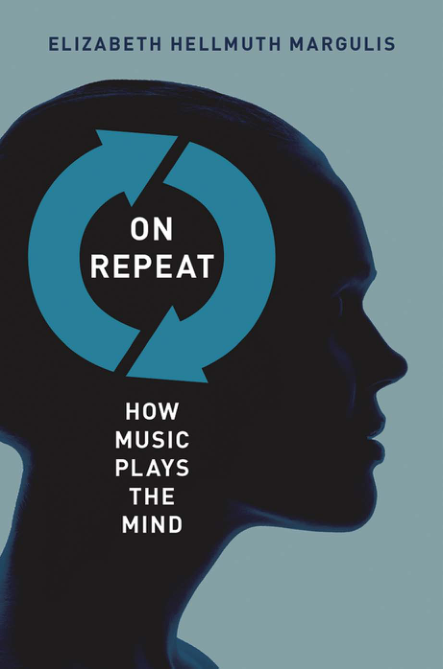
# On Repeat: How Music Plays the Mind
## Metadata
- Author: [[Elizabeth Hellmuth Margulis]]
- Full Title: On Repeat: How Music Plays the Mind
- Category: #articles
- Summary: insert summary
- My notes:
- Summary: The book "On Repeat" by Elizabeth Hellmuth Margulis explores the significance of musical repetition and its impact on our cognitive experience. It argues that musical repetition is not just a feature of music but a fundamental aspect of how we engage with it, affecting our enjoyment and perception. Modern technology allows composers to play with repetition in ways that enhance our listening experience and reflect postmodern attitudes.
- URL: https://readwise.io/reader/document_raw_content/247230898
- Source File: On Repeat HOW MUSIC PLAYS THE MIND ELIZABETH HELLMUTH MARGULIS (2020-12-14 15-39-01).pdf
## LLM Chats
## NotebookLM
## LLM Audio
## Highlights
> A stronger, less careful interpretation of these data could argue that repetition in general allows for the freeing up of att entional resources, such that att ention can rove to diff erent levels of the stimulus—up to higher-level, structural fea- tures (such as plot and character, in the case of the repeated TV show), or down to lower-level, detailed features (such as novel words, in the case of the repeated tellings of a story). S ([View Highlight](https://read.readwise.io/read/01jf7dzvzs6m2n7tsjt4s3ckxc))
> Encoding passages as sequences, where the fi rst bit is tightly connected to the second, which is tightly connected to the third, and so on until a point of rest, allows an entire phrase or section to be passed through with a degree of automaticity, such that the listener’s att ention is free to move up or down in the temporal hierarchy. Both the sense of embodying an external stimulus in the way that you’d ordinarily embody a physical action, and the play- ful exploration made possible by the att entional shift s, are intrinsically pleasant, ([View Highlight](https://read.readwise.io/read/01jf7dxyex2ymzxft84r6w4z8w))
> Broadly speaking, musical repetitions push processing down from the more cognitive, conceptual regions of the frontal cortex and into the more motoric, automatic basal ganglia. Encoding passages as sequences, where the fi rst bit is tightly connected to the second, which is tightly connected to the third, and so on until a point of rest, allows an entire phrase or section to be passed through with a degree of automaticity, such that the listener’s att ention is free to move up or down in the temporal hierarchy. Both the sense of embodying an external stimulus in the way that you’d ordinarily embody a physical action, and the play- ful exploration made possible by the att entional shift s, are intrinsically pleasant, and set up the kind of circumstances within which the strong musical experi- ences reported by Gabrielsson can happen. In Dry Salvages from Four Quartets (1968), T. S. Eliot describes a “music heard so deeply/ that it is not heard at all/ but you are the music/ while the music lasts.” Th is sense of extended subjectivity sounds a lot like the kind of experience that can arise from the sequential encod- ing of repeating music. ([View Highlight](https://read.readwise.io/read/01jex5ydg1ye7v9jmgdy1p66n8))
- Tags: [[kriegel paper]]
> When a musical passage is repeated and encoded more and more robustly as a sequenced unit, it serves as a literal hook, compelling a person to execute the sequence imaginatively until a resting point is reached. Music, in these cases, can seem to play the person. ([View Highlight](https://read.readwise.io/read/01jex61wsbqd5aa58778frdvh3))
> in the tendency of contemporary art music either to suff use itself with or entirely reject repetitiveness. Technology made it impossible to remain neutral ([View Highlight](https://read.readwise.io/read/01jejmb9s036qaq63q48dxy0e0))