# Philosophy_of_Technology_Essay
## Metadata
- Author: [[readwise.io]]
- Full Title: Philosophy_of_Technology_Essay
- Category: #articles
- Summary: insert summary
- My notes:
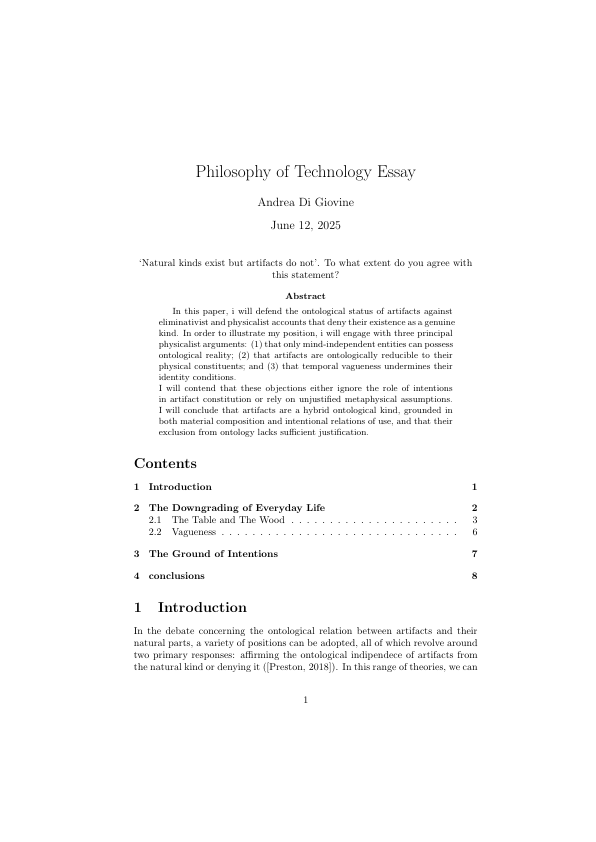
- Summary: This essay argues that artifacts are real entities that cannot be fully explained by their physical parts alone. It says artifacts exist because they combine material objects with human intentions and use. Therefore, artifacts form a unique kind of being that is different from natural things.
- URL: https://readwise.io/reader/document_raw_content/326553325
## LLM Chats
## NotebookLM
## LLM Audio
## Highlights
> rid ontologica ([View Highlight](https://read.readwise.io/read/01jye1j5y9yjk5yyth73kravb9))
> s ([View Highlight](https://read.readwise.io/read/01jye1j6nqx0gvqp56h1bnksj8))
> natural parts, ([View Highlight](https://read.readwise.io/read/01jye1s8nsb751rmaw3jwx2pc7))
- Note: what's a natural part
> There exist many kinds of vagueness, but here i am talking about temporal vagueness only, which concerns indeterminacy about the exact moments when an object comes into existence and expires. ([View Highlight](https://read.readwise.io/read/01jye1v0xwkzyvdm5vjsbvex6v))
- Note: this seems a very very long introducion for a 400 word paper
> Eliminativist physicalism has deep roots in the history of western philosphy, dating back to Aristotle, who denied the existence of those things that are crafted by art, mantaining that only things that exist by nature truly exist. T ([View Highlight](https://read.readwise.io/read/01jye1vvhhebfg91znzxbmytrb))
- Note: good
> Now, Since ([View Highlight](https://read.readwise.io/read/01jye1wwqp5df9jqyagp8e8w9t))
- Tags: [[couple of typos]]
> In contrast to the exclusion of mind-dependant objects from the ontological debate, Thomasson ([Thomasson, 2009]) argued that physicalist objections all conflate being a real kind with being a natural kind. Indeed, we have no reason to exclude from the debate mind-dependent object such as money, countries, family, artifacts and so on. ([View Highlight](https://read.readwise.io/read/01jye1yywmrgvn3zey8g8rrn9y))
> Furthermore, we have good reasons to at least investigate mind-dependent objects in an ontological way,because they play a role in the explanatory framework not only of everyday life and almost every social science, but also in many natural science. F ([View Highlight](https://read.readwise.io/read/01jye207x7xecgqx86yggg6h5j))
> o ([View Highlight](https://read.readwise.io/read/01jye22ayhncb7xh7xwbd0xc0c))
- Note: huh?
> To affirm that we lack good reasons to accept artifact kind in our ontology is not enough to exclude their existence. T ([View Highlight](https://read.readwise.io/read/01jye21r7f4dhf8msm9y4w4srn))
> Moreover, since the issue is closely tied to the ontological kind of the entity in question, the response ’there is only me here’ simply sidesteps the matter, failing to address the question of whether the entity in question is a snake or a hammock. Indeed, if someone- someone not under the influence of allucination- were to pass by the place where the snake-hammock had been hung, they would be reluctant to accept that what they are looking at is a snake. And if we ourselves are not under the influence of hallucinations, then we too should be reluctant to accept that what we are seeing is a snake. ([View Highlight](https://read.readwise.io/read/01jye2658xpz7eh2cph188fy3v))
> While it is certain that natural kinds belong to the category of physical entities, artifacts—being entities dependent on intentions linked to a substrate of matter—are not reducible to mere material entities. The mental constitutive component of the artifact kind therefore provides grounds to support the difference in kind between artifacts and natural entities, and consequently, the possibility of spatial overlap between artifacts and natural objects. ([View Highlight](https://read.readwise.io/read/01jye27snm2r7sgj0a9bn1zxg2))
- Note: isn't this just assertion
> If the reductionist in question accepts the existence of human beings—if they reject the claim that ’person’ is merely a name for flesh, bones, and muscles with a brain and a nervous system, and that there are no persons or human beings, only aggregates of flesh—then they should likewise reject the claim that ’table’ is simply a name for wood at a certain point in its career. ([View Highlight](https://read.readwise.io/read/01jye2artd7vkkwqbbsr9zmpg3))
> Furthermore, Baker ([Baker, 2007]) claimed that the temporal vagueness is a real property of ([View Highlight](https://read.readwise.io/read/01jye2f3h507ehj0hy28gwvw51))
> the relation occuring between an artifact and its component. ([View Highlight](https://read.readwise.io/read/01jye2f67bhmaz8n3csyrdgw36))