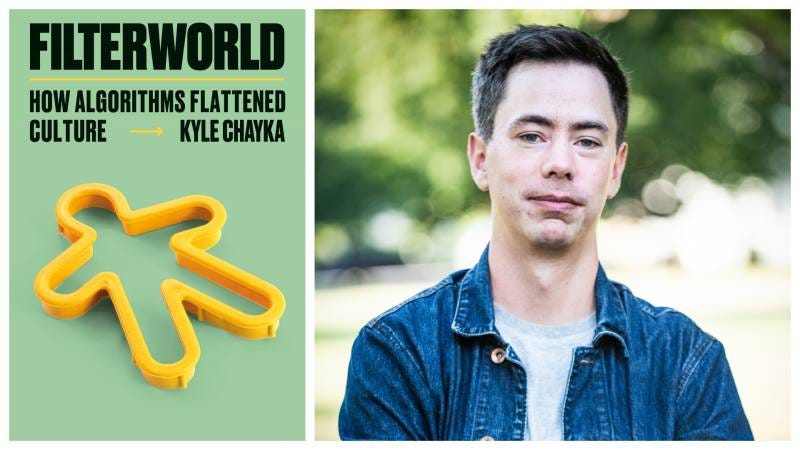
# Review: Kyle Chayka's Filterworld
## Metadata
- Author: [[Freddie deBoer]]
- Full Title: Review: Kyle Chayka's Filterworld
- Category: #articles
- Summary: insert summary
- My notes:
- Summary: In "Filterworld," Kyle Chayka explores how algorithms have flattened cultural production, shifting from human curation to digital recommendations that influence offline life. Chayka delves into how algorithms shape arts, media, and culture, emphasizing the impact on aesthetic values and the mimetic nature of contemporary creation, often seen in memes. He discusses the democratization of creation tools alongside the challenges of standing out in oversaturated platforms, highlighting the influence of technology on cultural evolution. Chayka's book prompts reflection on breaking aesthetic rules, the dominance of algorithms, and the complexities of recent history in the digital age.
- URL: https://freddiedeboer.substack.com/p/review-kyle-chaykas-filterworld
- Source File: web-only
## LLM Chats
## NotebookLM
## LLM Audio
## Highlights
> I think that last part is underdiscussed and very important. Part of what defined the Instagram look was that its images were suitable for a portrait orientation, and portrait orientation is important for an app because turning one’s phone to look at it makes it less likely that you’ll use that app reflexively, obsessively. Form followed function that followed form; what was popular was decided by what people thought good but what they thought looked good was dependent on tech industry choices made far far above their heads. This is core to Chayka’s overall analysis - algorithms spring from the specific needs of individual tech companies, those needs are dictated by influences that have nothing to do with aesthetics, and yet algorithms inevitably dictate aesthetic habits; the convenience of a few coders in Silicon Valley becomes more influential on our shared aesthetic values than Anna Wintour. For years visual culture was Instagram culture, to a striking degree, and Instagram photos were square, and so visual culture was dependent on square images, based on decisions Apple made about the form factor of a new product in development in the mid-2000s. This randomness, the way minor practical decisions made with utter apathy to visual culture drive visual culture, haunts Filterworld, and *Filterworld.* ([View Highlight](https://read.readwise.io/read/01hsmrcxv222fdmvr3qfs8ergk))