# Seeing Shadows
## Metadata
- Author: [[Philosophia]]
- Full Title: Seeing Shadows
- Category: #articles
- Summary: insert summary
- My notes:
- Document Tags: [[refereeing]]
- Summary: This paper argues that shadows can be perceived as bona fide pictures, despite their non-pictorial appearance. The author uses Wollheim's seeing-in theory to show that shadows can represent their objects and have pictorial value. Ultimately, the perception of shadows aligns with the criteria for being considered genuine pictures.
- URL: https://readwise.io/reader/document_raw_content/267284026
## LLM Chats
## NotebookLM
## LLM Audio
## Highlights
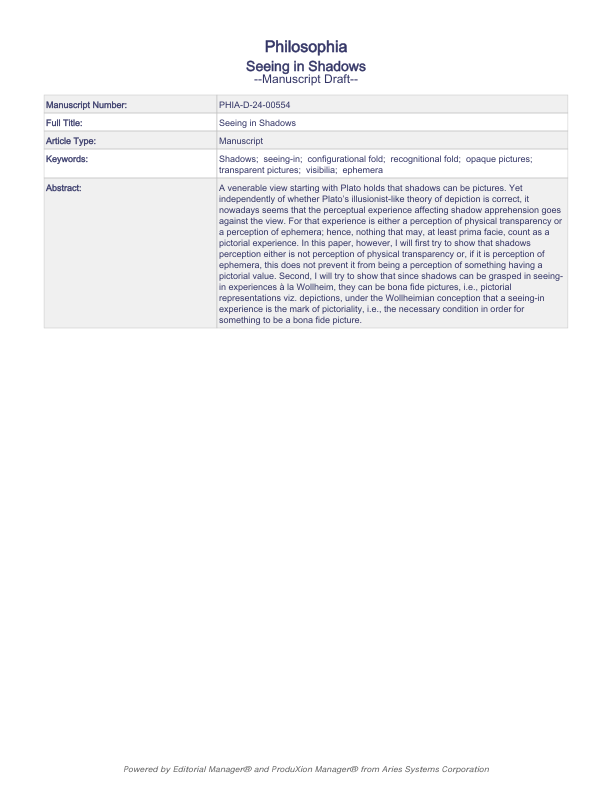
> PHIA-D-24-00554 ([View Highlight](https://read.readwise.io/read/01jpmbpqrvb4y0m5d84dj996qh))
> As is well known (e.g. Gaiger 2008), Plato is taken to be a forerunner of the illusionist account of depiction; n ([View Highlight](https://read.readwise.io/read/01jpmc3930c2e8d8kjajgvxxvq))
- Note: Is it that well known?
> mobilize illusionistic factors, ([View Highlight](https://read.readwise.io/read/01jpmc4en65fq2d9xy21pxzmgh))
- Note: I don't know what this means
> Obviously enough, however, neither Plato’s theory of depiction, nor the illusionist account, is my concern in this paper. For the problems of illusionism do not per se undermine the venerable view that shadows can be bona fide pictures. ([View Highlight](https://read.readwise.io/read/01jpmc6g5ytxvwnstbk6g56q98))
- Note: I don't think this is a very good way of starting the paper. If you're not going to talk about Plato's theory then you shouldn't spend the first five sentences talking about Plato's theory.
> On the face of it, even one puts illusionism aside, one may still say that “a cast shadow is an image of the caster” (Casati 2004:1389). ([View Highlight](https://read.readwise.io/read/01jpmc8hnard1gjcrbar95my7y))
- Note: Why is this here? I don't understand what it means by 'one may still say' . Who? Casati? The author? Are we in favour of this view or not in favour of this view?
> Yet the venerable view no longer seems to be appealing nowadays: “It is possible […]to treat shadows of things like pictures of them, but this is not at all our usual practice” (Maynard 1985:120). ([View Highlight](https://read.readwise.io/read/01jpmca1svb6avjbag51gzen32))
- Note: I don't understand what the purpose of the previous paragraph was supposed to be.
> vicarious visibilia ([View Highlight](https://read.readwise.io/read/01jpmceps6q49hcxj29xdbf2m6))
- Note: Nice turn of phrase
> In this paper, I want to vindicate the venerable view. By appealing to Wollheim (1980, 1987, 1998, 2003a,b) seeing-in theory of depiction, shadows can turn out to be bona fide pictures just like any other. For just as any ordinary picture, they are affected, for adequate spectators, by a sui generis perceptual twofold experience of seeing-in. For Wollheim, this experience is the mark of pictoriality; namely, it is the necessary condition for a representation to be a pictorial representation, i.e., a depiction. ([View Highlight](https://read.readwise.io/read/01jpmcfypnwczvvmkx14k0jh0c))
- Note: This point should have been gotten to much earlier
> This is the kind of perceptual experience of physical transparency that one normally entertains when seeing a background object through a medium object that is physically transparent, since the medium object lets light reflected by the background object pass, often merely partially, through it. ([View Highlight](https://read.readwise.io/read/01jpmcnet4xda3t500nrz0m0f9))
- Note: This sentence confuses things by putting the idea that's already being expressed in different terminology. I suggest talking about the caster in this sentence rather than waiting until the next one.
## New highlights added March 25, 2025 at 8:26 AM
> Following an established usage, let me call casters the objects ([View Highlight](https://read.readwise.io/read/01jq60ncv40r5w9c0m1akd8c2m))
- Note: very unclear and i think incorrect
> projecting light on surfaces, call them screens. ([View Highlight](https://read.readwise.io/read/01jq60nfj4gn62br1esyb223xd))
> In what follows, I will take Wollheim’s claim for granted. I will limit myself to slightly reconceiving the seeing-in experience, in order to show how it can affect shadows as well. ([View Highlight](https://read.readwise.io/read/01jq6180zex4wbbraz60k4tce4))
- Note: hmmm
> Section 3 concludes. ([View Highlight](https://read.readwise.io/read/01jq618a5hvrp71vrg2c8czf07))
- Note: ugh
> At this point, one either radically says that, since objects working as media in a perception of physical transparency are no pictures of their background of objects, qua media in a similar perception shadows are no pictures of their casters ([View Highlight](https://read.readwise.io/read/01jq619qwjhnxpc69bame3zwxv))
- Note: not super clear what this means
> movie snapshots and reflections in general, are pictures of their casters in a specific sense, once they are taken to be pictures of a sui generis kind: transparent pictures, which flank pictures of another sui generis kind, opaque pictures (drawings, paintings and sketches). For Walton, unlike opaque pictures, transparent pictures are such that not only they are just like media in a perception of physical transparency, but they also stand in a causal relation with their background objects; namely, the objects literally seen. Indeed, that relation sustains a counterfactual dependence: if the background object changed, so would the transparent picture change. For a moderate, the same holds of shadows, once they are taken as media in a perception of physical transparency: if the caster changed, its shadows would change as well.2 ([View Highlight](https://read.readwise.io/read/01jq61fp4fgh8gdkd4krcvykt0))
- Note: this whole paragraph is really difficult to understand.
> Chinese shadows ([View Highlight](https://read.readwise.io/read/01jq61zfe0e7s0tr0q8dzwtc11))
- Note: chinese shadow puppetry
## New highlights added March 25, 2025 at 12:41 PM
> transparency, the background object and the medium object are connected in one and the same perceived scene. Not only, by means of its occupying an intermediate position between the background object and the perceiver, in that scene the medium object filters the light the background object reflects. But also, the background object is a necessary component of that scene, since if the former changed, the latter would change as well. Yet in shadow perception, not only the shadow does not filter the light received by caster – it is a light absorber – but also the caster may not belong to the perceived scene containing the shadow. Hence, if the caster were replaced by another object, notably an object of the same dimensions, the scene with its shadow would not be altered at all.3 ([View Highlight](https://read.readwise.io/read/01jq64b0g26skp69nsev164w42))
- Note: this is a major problem with this paper: it does not engage properly with Yetter-Chappell's arguments about why we do see through shadows in the same way that we see through mirrors. She explicitly addressess the absorber/reflector question in 3.4 of her paper. e.g. 'privileging information transmitted by light reflection seems like quite an arbitrary way of carving a line between seeing and not-seeing'
> As for the first reason, the distinction between opaque and transparent pictures, taken as a kind distinction, has already been widely criticized, e.g. by claiming that, properly speaking, there are no transparent pictures in Walton’s sense (Currie 1991). T ([View Highlight](https://read.readwise.io/read/01jq678czrndashj7eadgbzvqg))
- Note: this sentence pretty much contradicts the sentence before it.
> For me, moreover, the second reason to reject the opaque-transparent pictorial distinction is that there are three arguments showing that there are no transparent pictures taken as pictures of a particular kind, to be distinguished from opaque pictures taken as pictures of another kind. Interestingly enough, such arguments can also be presented by mobilizing shadows. If these arguments are sound, then shadows cannot be transparent pictures in Walton’s sense. ([View Highlight](https://read.readwise.io/read/01jq67a1nbxm3h1gzrn50ry9er))
- Note: i don't follow.
> 3 One may claim that shadows are objects of phenomenal transparency (cf. Newall 2015:137). ([View Highlight](https://read.readwise.io/read/01jq64x7awc2qas8kke5nbpd35))
- Note: without more information a reader isn't going to know what an 'object of phenomenal transparecny' is. (I do know phenomenal transparecny means but I am still unclear what an object of PT means)
> perceptually trafficking ([View Highlight](https://read.readwise.io/read/01jq67j6zpz764rwamxxtd0b8m))
- Note: ???
## New highlights added March 28, 2025 at 10:26 AM
> no pictures ([View Highlight](https://read.readwise.io/read/01jqdyy12s6vj80x0npaza9rkn))
> Yetter-Chappell ([View Highlight](https://read.readwise.io/read/01jqe0g61dk86evyzx9fwbjmxp))
> Yetter-Chappell, ([View Highlight](https://read.readwise.io/read/01jqe0gyejdrvysrkgbaktzzvb))
## New highlights added March 28, 2025 at 11:26 AM
> ting light on surfaces, call them screens. B ([View Highlight](https://read.readwise.io/read/01jqe1dj7whnkrhkj24297s0e3))
> projecting light on surfaces, call them screens. ([View Highlight](https://read.readwise.io/read/01jqe1e84ep7de3p7s0dkbtrr2))