# Synt_d24_01771
## Metadata
- Author: [[125]]
- Full Title: Synt_d24_01771
- Category: #articles
- Summary: insert summary
- My notes:
- Document Tags: [[refereeing]]
- Summary: Music can be seen as both an art form and a tool that helps us express and extend ourselves beyond our physical bodies. It influences our thoughts, feelings, and social interactions, making it a crucial part of human experience. Throughout history, music has served various purposes beyond mere enjoyment, highlighting its importance in cognitive and emotional processes.
- URL: https://readwise.io/reader/document_raw_content/253961550
## LLM Chats
## NotebookLM
## LLM Audio
## Highlights
> D-24-01771 ([View Highlight](https://read.readwise.io/read/01jjbq6hqew37e03egmj320fc1))
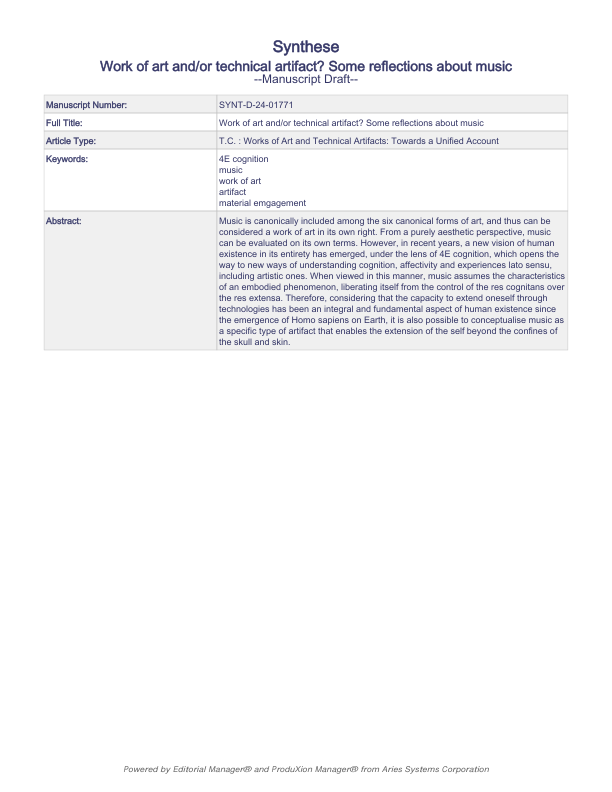
> Music is canonically included among the six canonical forms of art, and thus can be considered a work of art in its own right. ([View Highlight](https://read.readwise.io/read/01jjsch6x6qvxd35mh0hbfknfn))
- Note: I am not sure this sentence makes sentence
> However, in recent years, a new vision of human existence in its entirety has emerged, ([View Highlight](https://read.readwise.io/read/01jjsck9b2t4vdmbyy63pbm8xt))
- Note: hyperbole
> lato sensu, i ([View Highlight](https://read.readwise.io/read/01jjscnrsn2pgf3fng0tb9n630))
- Note: i don't think having latin in the introduction is a very good idea –the abstract is meant to tell the reader what the text is about, but not everyone will no every latin phrase.
> it is also possible to conceptualise music as a specific type of artifact that enables the extension of the self beyond the confines of the skull and skin. ([View Highlight](https://read.readwise.io/read/01jjscrc0zf5hvspvtj8wjafmm))
- Note: nice idea, but not very clearly definied.
> l emgagement. ([View Highlight](https://read.readwise.io/read/01jjscj59ksa3mhxtwrq7rermm))
- Note: spelling
> this is the case for all human beings who make up social groups and for humanity itself as a phenomenon. ([View Highlight](https://read.readwise.io/read/01jjscsb42gy8gcfz5hhm6m8ez))
- Note: what is this supposed to mean?
> e spirit ([View Highlight](https://read.readwise.io/read/01jjscsyp4vgwf5k45yqqmdkzf))
- Note: not very philosophical
> These media have been a constant in our lives since they first appeared, they are our means of extending ourselves and reaching out into the world beyond every conceivable boundary, first and foremost the corporeal. ([View Highlight](https://read.readwise.io/read/01jjsctjz9x6xnq0h5hwjxmbp5))
- Note: this is vague and slightly hyperbolic
> In §2 we will give a general overview of the human ability to extend itself through technologies, ([View Highlight](https://read.readwise.io/read/01jjscvk3m6cc1942xv8c2kedz))
- Note: would it not be better to couch this in a sort of 'if we accept 4E then...'. Not every reader, less than half most likely is going to agree with the 4e cognition hypothesis, but this sentence makes it seem as though it is obviously true
> The ability to interact with the environment by modifying it is in fact a characteristic that can be observed from the appearance of man on Earth to the present day, ([View Highlight](https://read.readwise.io/read/01jjv8gnkj75jtcyp1bcyra5a7))
> The ability to interact with the environment by modifying it is in fact a characteristic that can be observed from the appearance of man on Earth to the present day, although when we think of technology we often tend to associate it with today's complex technologies. ([View Highlight](https://read.readwise.io/read/01jjscyvndm6bb45gz44k6t2zw))
> In fact, on closer inspection, even a simple tool is a technology, since it consists of a natural object that has been deliberately modified to achieve a specific purpose. ([View Highlight](https://read.readwise.io/read/01jjsczc0jwjwrqxbhhfrc9m95))
- Note: 'on closer inspection' suggests that this is not obvious. All philosophers of technology would say that natural artifacts that have been modified are technology.
> I ([View Highlight](https://read.readwise.io/read/01jjsd1ga2hmpdwr3wsvgyqcty))
- Note: in the previous paragraph the author(s) referred to themselves as 'We' now it is 'I'
> In §3 I will discuss the possibility of considering music as an artifact, reviewing the main types theorised so far: embodied artifact, perceptual artifact, cognitive artifact, affective artifact, aesthetic artifact, communicative artifact and experiential artifact. ([View Highlight](https://read.readwise.io/read/01jjsd2thj3t9q7n2tka9adpaj))
> The evolutionary success of humans is not attributable to any specific biological or physical default abilities. ([View Highlight](https://read.readwise.io/read/01jjsd3t93ev0p3x07yk8dah26))
- Note: i don't know what this means. couldn't we say the same about any living thing? also, what is the difference between a physical ability that humans have verses a biological ability that humans have? What is a default ability?
> The lack of specialised traits such as tusks or strong muscles, and the absence of specific abilities such as flying or running at high speeds, has compelled humans to establish their existence in a fundamentally distinct manner compared to other animals. ([View Highlight](https://read.readwise.io/read/01jjsd7mtscvar8wax47eswmz3))
- Note: this is not written well: the meaning would be that it is the LACK which causes human's to exist in a distinct manner, but don't you want to say that it is our adaptability, jack of all trades ability that has allowed for this fundamentally different existence.
> It can be argued that human beings are biologically predisposed to interact with their environment ([View Highlight](https://read.readwise.io/read/01jjsdbwhg5tmsv4w3pbk8j6qn))
- Note: surely all living creatures are..
> This utilisation of tools is not merely causal in nature; rather, it is driven by a tangible objective, which may also extend beyond the immediate context. For instance, play is an activity that humans engage in purely for enjoyment, rather than for any practical purpose. In contrast, animals engage in purposive play, which is not exempt from the underlying biological imperative to reproduce. In this way, human beings experience the world, reduce it and condense it into symbols in order to gain a comprehensive understanding of it and the capacity to act upon it as they see fit. The evolutionary success and continued existence of the human species is therefore due to its capacity to externalise through the development of technologies that extend various functions. ([View Highlight](https://read.readwise.io/read/01jjsdexn5hndej1py7fbedmv5))
- Note: this is a lot of words to say not very much
> By transcending the hierarchical structures of agents, things, and environments, these avenues facilitate a reinterpretation of phenomena from a radically different perspective. ([View Highlight](https://read.readwise.io/read/01jjsdh3h03pmcdbt29y644qze))
- Note: meaningless hyperbole
> and ascribing meanings to it. ([View Highlight](https://read.readwise.io/read/01jjsdhtcrjkpq1kdpqzcgs0x8))
- Note: what does this mean? Meaning hasn't been mentioned so far
> . Consequently, the environment can only be experienced through the mediation of the agent body. I ([View Highlight](https://read.readwise.io/read/01jjsdjqkv8ejzp9e9x39njn5b))
- Note: how else would it be experienced?
> The greater the variety of relationships between the elements that comprise the system, the greater the degree of complexity inherent to the system itself. Indeed, when human-environment interaction is viewed through the lens of a reductionist approach, it may be erroneously perceived as a closed system, comprising distinguishable parts (such as man and environment, or man and man, etc.) that can be disassembled, ordered, and reassembled. ([View Highlight](https://read.readwise.io/read/01jjsdkb63d7be22nw9wr6eywa))
- Note: why am I being told this?
> The manipulation and utilisation of tools are not merely the result of the interaction between inert materials and a world in the background; rather, they are the consequence of a profound complexity of interaction between these elements. T ([View Highlight](https://read.readwise.io/read/01jjsdkz2nhg49dp6qjep49dqv))
- Note: meaningless hyperbole
> conceptual reworking ([View Highlight](https://read.readwise.io/read/01jjsdmc7jgv8e2a1z5ke3hxx5))
- Note: why conceptual?
> Once the task of locomotion has been delegated to technology rather than the limbs, a number of conceptual shifts have occurred. ([View Highlight](https://read.readwise.io/read/01jjsdn644syze5zts0axp0t31))
- Note: we still use our limbs for locomotion..
> . Firstly, the ability to think about something else while moving has been made possible. ([View Highlight](https://read.readwise.io/read/01jjsdnw7snte75e9x00gnknvt))
- Note: there is no reason to think that this is because we created technology to help us move
> The aforementioned points pertain to a tangible and objective aspect, encompassing both the tactile and visual realms. ([View Highlight](https://read.readwise.io/read/01jjsdqam2xeq8m898vfzg08ey))
- Note: i don't know what this means.
> When considering the creative process in its entirety, the same approach can be applied to other forms of extension, including music. ([View Highlight](https://read.readwise.io/read/01jjsdqxvpmbsk6ygwy4y48pt8))
- Note: why is music a form of extension
> This can be regarded as a complex phenomenon that is intrinsic to the action-perception cycle, resulting in outcomes that, as might be expected, fall within the domain of works of art. ([View Highlight](https://read.readwise.io/read/01jjsdrtscme2yvdmtzc5e3qnm))
- Note: i don't know what this means
> In fact, human beings are capable not only of generating sounds, but also of organizing them according to isochronous beats and pitch scales, thus creating the peculiar organization of sounds that is music. This peculiar organization of sound -i.e. music-, is also particularly functional because it creates an emotional resonance that underlies social bonding by eliciting biological signals that can be understood by any human being, unlike other forms of communication (such as language, which requires learning to decode). ([View Highlight](https://read.readwise.io/read/01jjsdtffn79n8pxv3rrkdprb2))
- Note: The idea that music functions to create emotional resonance hasn't been argued for.
Music is not understood by every human being. Newborn babies, for example? What about other cultures' music? Gamelan doesn't resonate for teenagers in France (for example).
> To elucidate, if one considers music solely in terms of its performance and consumption, one is inclined to associate it primarily with the domain of the work of art. However, if one contemplates music as the act of playing an instrument, listening to a song on the radio, or attending a performance, an alternative aspect of the phenomenon emerges, namely that specifically related to embodiment, affectivity, and aesthetic experience. ([View Highlight](https://read.readwise.io/read/01jjsdzd9nkkan8sz51brzf50x))
- Note: playing an instrument = performance
listening = consumption
> It is worth considering that constituting themselves as musical beings was not an economically advantageous process for humans from an evolutionary standpoint. ([View Highlight](https://read.readwise.io/read/01jjse1fv12zezep12y08y06zc))
- Note: what has economics got to do with evolution?
> It is worth considering that constituting themselves as musical beings was not an economically advantageous process for humans from an evolutionary standpoint. ([View Highlight](https://read.readwise.io/read/01jjv79ax1j7ff86s9f87z8mzr))
> The production of musical instruments and the utilisation of these instruments required a significant expenditure of energy, which was not an efficient use of resources. Furthermore, the social context in which these performances occurred frequently involved the exchange of sounds that led to the execution of seemingly intentional gestures, prompting individuals to move in rhythm or actively engage in the performance, even if they were not the primary author. This suggests that this practice was not without inherent risks «music is loud (attracting attention of predators or enemies) and energetically expensive (sometimes to the point of exhaustion), and if music had no value whatsoever, one might expect strong selection against musical behaviour.» (Fitch, 2006: 200). ([View Highlight](https://read.readwise.io/read/01jjse2ssg3znt2431bgpqs3hs))
- Note: this evolutionary story seems very quick are there not alternatives? What about Pinker's 'musical cheesecake' idea
> (which clearly refers to the ([View Highlight](https://read.readwise.io/read/01jjse516qcp65xtf5cc9ar6xc))
- Note: why does it clearly relate to the mind/body problem?
> artifacts. ([View Highlight](https://read.readwise.io/read/01jjse3x91t9nyvc4kz24eeyfm))
- Note: this is an enormouslly long paragraph and difficult to read because of this.
> The second type of artifact refers to the possibility of improving and enhancing perception of the world, ([View Highlight](https://read.readwise.io/read/01jjse6r6b1h5w4c0wpdze06pr))
- Note: are these really the only two?
> An illustrative example of a perceptual artifact in the musical domain is the Adactive Digital Musical Instruments (ADMI), exemplified by Michel Waisfisz's The Hands (Torre et al., 2016) and Laetitia Sonami's Lady's Gloves (Son As evidenced by studies such as those conducted by Ami (2006) and Reid et al. (2018), research in the field of Human-Computer Interaction has led to the emergence of a distinct area of study situated between Wearable Technologies (WT) and Digital Musical Instruments (DMI). ([View Highlight](https://read.readwise.io/read/01jjse89j5phqgkq0axzdqcece))
- Note: given that none of these examples are explained they are very very far from illustrative
> inclusivity. ([View Highlight](https://read.readwise.io/read/01jjv49dy0tvj4tvqch69kb63p))
- Note: again, I don't understand. what does inclusivity havre to do with anything?
> retroactive effect ([View Highlight](https://read.readwise.io/read/01jjv4e1mzna99rg32nmtvkvaa))
- Note: how is this effect retroactive
> immaterial artifacts ([View Highlight](https://read.readwise.io/read/01jjv4et9mpxdjpzf8dv0a1taw))
- Note: there's no explanation of what an immaterial artifact is.
> , responding more to an exclusive and individual characterisation. ([View Highlight](https://read.readwise.io/read/01jjv4h86p07wy77399d1bacb0))
- Note: again, i have no idea what this means
> The act of music-making is inherently exploratory, whether it be the performance of a piece by an experienced musician or the initial perceptive contact of an infant. Each performance represents a further exploration of the instrument by the musician, who devises new possibilities of sound, dynamics, and strategies for executing difficult passages. ([View Highlight](https://read.readwise.io/read/01jjv4j3cmz0a7hdwwzm4rj22a))
- Note: this is so bad.
> t no Each ([View Highlight](https://read.readwise.io/read/01jjv4jrwqbj9z5zhvf56s7g7j))
- Note: grammatical error
> The musician's surroundings undergo a transformation, with the instrument itself also undergoing a change. If the instrument is a piano, it undergoes a complete transformation; if it is a portable instrument, the weather, humidity, grip on the strings, reed, and other factors influence its condition. The audience, the performer's state of mind and their physical predisposition are also subject to change. ([View Highlight](https://read.readwise.io/read/01jjv4kvcqgqa4rah9tgxddpzc))
- Note: what? why are you talking about weather? I don't understand any of this.
> a high degree of improvisation, or ensembles in general, ([View Highlight](https://read.readwise.io/read/01jjv4ty3ywg1yw40md66kzz37))
- Note: not well written
> even if one is simply expressing their enjoyment or other feelings connected with listening. ([View Highlight](https://read.readwise.io/read/01jjv52enhv6v0nz7k3mr32z72))
- Note: this suggests that it is surprising that one might aesthetically appreciate something by expressing their enjoyment or other feelings.
> Consequently, the musical mind and its emotional components can be conceptualised as being inextricably linked to the same cyclical dynamics of autonomy and sense-making that ultimately define the autopoietic nature of life itself (Schiavio 2017). Cognition is linked to an individual and social dimension of sense-making (De Jaegher and Di Paolo 2007) and this is inseparable from a combination with the environment experienced in enactive but also affective terms, it follows that cognition and the affective dimension cannot be separated. In this perspective, musical actions (from production to active listening) always have an emotional-affective orientation. ([View Highlight](https://read.readwise.io/read/01jjv57haernpmsbyzc1a5aqzr))
- Note: ????
> 4. Some examples from history of music ([View Highlight](https://read.readwise.io/read/01jjv5bxssng99bbm3w9wggpfp))
- Note: these examples that follow are very long, and do little to add to the overall account that the paper presents.
Also, all of these examples are entirely obvious and entirely unsurprising. Everyone knows that music can be used in a tool like way. this is not an interesting point to make. Neither is it engaging with the interesint parts of terrone's claims