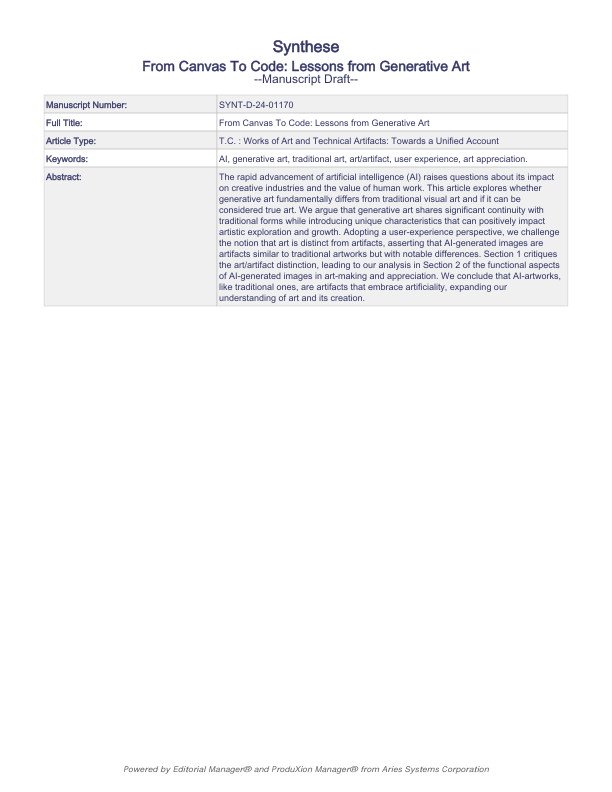
# Synt_d_24_01170
## Metadata
- Author: [[129]]
- Full Title: Synt_d_24_01170
- Category: #articles
- Summary: insert summary
- My notes:
- Summary: The text explores how AI-generated art blurs the line between art and artifacts, suggesting that AI artworks can be considered artifacts similar to traditional art but with unique characteristics. It argues that both types of art serve aesthetic purposes and that AI's role expands the definition of creativity and artistic collaboration. Ultimately, the discussion challenges traditional views on what constitutes art and who can be recognized as an artist in a technologically evolving landscape.
- URL: https://readwise.io/reader/document_raw_content/232770101
## LLM Chats
## NotebookLM
## LLM Audio
## Highlights
> From Canvas To Code: Lessons from Generative Art ([View Highlight](https://read.readwise.io/read/01jbkdjttk1q08wvf16g34a9k5))
- Note: Generative art is not the correct term
> On this schema, art begins with something mental, then turns into something physical, and that physical thing then allows for a mental process to occur. ([View Highlight](https://read.readwise.io/read/01jbkeq2zrb2577rms71br989q))
> If art involves a material transfer of creativity into a creation, then the created object is, in a ways, a unique vessel for that creative act. ([View Highlight](https://read.readwise.io/read/01jbker3hr6b7mjw6sstxpdmnr))
> The CCA conception can also be used to explain why it is tempting to draw a sharp distinction between artworks and artifacts. Once we see art as having appreciation as its end, one might be inclined to say it lacks utility. ([View Highlight](https://read.readwise.io/read/01jbkf1yfd340n542vwbb9pthn))
> On the CCA account, there is a transfer from artist (a creative genius perhaps) into a physical object that now harbors these special qualities. ([View Highlight](https://read.readwise.io/read/01jbkf42q10880ddjvcgrnqxcb))
> It is a direct encounter with ethereal qualities that creators have planted into physical objects. ([View Highlight](https://read.readwise.io/read/01jbkf56pc27j8vf99wtbn6crt))
> That virtual entity can be stored, shared, and uploaded. It is not an irreplaceable one-of-a-kind object in the way traditional artworks are. And, finally, while appreciation of digital works may share much in common with appreciation of traditional artworks, something seems to be lost. As mechanical reproductions, these works may be perceived as lacking aura. When we know that a work was created using an AI model, we also may withhold some terms of praise that would otherwise enter into our state of appreciation – terms such as original, skillful, or expressive. ([View Highlight](https://read.readwise.io/read/01jbkffdvpd25m7asf57gz5rcv))
> Here we arrive at the awkward conclusion that AI-generated works may lack both intrinsic value, for aforementioned reasons, and instrumental value. They lie, to that extent, somewhere between artworks and artifacts. ([View Highlight](https://read.readwise.io/read/01jbkfjgc6ahewswqebntgrthg))
> In addition, with these models there is some blurring between the boundary of the algorithm that generates the model and the output produced: both, after all, arise within the same computational system and are metaphysically alike. These is, in other words, a blurred boundary between the creativity and the creation. We traditional art, an metaphysical gulf, separates artist and artwork. With AI-generated art, the blurring brings the resulting images closer to the artifacts that create them. In this respect, such works can be regarded as penumbral. The hover unstably between act and object, creator and created, artifact and art. ([View Highlight](https://read.readwise.io/read/01jbkfmf8kgy99j2ch8n4d0783))
> We suspect that the insistence or art having a special kind or irreplaceability may stem, once again, from Romanticism and resultant magical thinking. Much art is irreplaceable, but this is a contingent feature and not one that places art into a realm radically unlike that of other physical objects. ([View Highlight](https://read.readwise.io/read/01jbkfxtj8md8sdjgejwvt6ve7))
> Artists must also listen to their materials and wrestle with the their limitations. Art is always a collaboration between a creator and a medium. ([View Highlight](https://read.readwise.io/read/01jbkg4rje198fjtcwj8ztst5w))
> Once we recognize that art is functional, it allows us to ask how a given kind of art functions. ([View Highlight](https://read.readwise.io/read/01jbkg5m3b5tyc34d382ena2tk))
> This brings us, at last, to our opening promise of motivating an approach to metaphysics based on user experience. If art is metaphysically linked to function, and we aim to arrive at a fine-grained analysis of the functions served by a particular kind of art, then we have much to learn from reflecting on how that kind of art works in practice. ([View Highlight](https://read.readwise.io/read/01jbkg7my276zrqeh5gwwd7sjp))
> We can make progress on the metaphysics of AI-generated art by inquiring into its use. Or particular value is the question of how artists working with generative models engage with this medium, and how these emerging and evolving practices compare to more traditional art making. In what follows, we will investigate the nature of AI art from this perspective. ([View Highlight](https://read.readwise.io/read/01jbkg9e5jb95mcg25tb01tkjg))
> We now want to explore how AI-generated images function in the context of making art. ([View Highlight](https://read.readwise.io/read/01jbkgbttp9pqxacd08kbcpa5a))
> AI generated images were once limited to technically inclined specialists mostly operating outside the art world. With the advent of deep learning and the public release of models trained on massive datasets, people without technical training can now easily produce images that resemble traditional painting, illustration, and photography. Untrained users can also generate professional sounding songs and orchestral pieces. We will focus here on generative image models. ([View Highlight](https://read.readwise.io/read/01jbkge25yvngzzh29t54zzb4s))
> A tendency to undervalue AI-created art compared to art made by humans, often denying its legitimacy and potential for development. This skepticism was evident during the first author’s own exhibition of AI-generated art in Brussels and in a Whitney Museum exhibition dedicated to Harold Cohen. Such resistance is
> exacerbated by fears that AI could replace traditional artists, highlighting a broader discomfort with the integration of technology in creative domains. ([View Highlight](https://read.readwise.io/read/01jbkgh51s7qzf3egpydczs2sh))
> We must first point out our that media always participate in artistic production. ([View Highlight](https://read.readwise.io/read/01jbkgj7rv29d3x6ypb1kj0ajc))
> AI-generated images resemble painting and photographs, but they are not made of paint of created by cameras. In this sense, they can be regarded as simulations. ([View Highlight](https://read.readwise.io/read/01jbkh20vtgy6qa2ymfbmjjq11))
> Even the digital realm, which lacks physical tangibility, images still serve as a robust medium for artistic expression. ([View Highlight](https://read.readwise.io/read/01jbkh4802dypjbxefszn5562n))
> This aligns with Davies’s concept of an artistic medium as a “framework of communicative possibilities,” where AI uses historical and emerging digital tools to articulate new artistic statements. This extends the communicative possibilities traditionally associated with digital technologies. AI art operates within a dual realm of mediums. Physically, it manipulates data—a new type of ‘stuff’ in the digital age—while artistically, it explores the communicative possibilities of this data, creating art that may or may not be meaningful, yet remains thought-provoking. The ([View Highlight](https://read.readwise.io/read/01jbkh72vqk6pgpnwk707rzbky))
> methods employed to create AI art reflect broader technological advancements and cultural shifts influencing contemporary art. ([View Highlight](https://read.readwise.io/read/01jbkh880f4xn412rrxtr275ea))
> expressive opportunities characteristic of art. ([View Highlight](https://read.readwise.io/read/01jbkha4s52j690gjyc372afdh))
> This process of creation aligns with the idea of altering or using preexisting materials (in this case, data and algorithms) to create something new, fitting the definition of art. Just as a piece of driftwood or a stone can be recontextualized as art when placed in a gallery, AI-generated works are given artistic status by being presented within an art context. ([View Highlight](https://read.readwise.io/read/01jbkhd7mxc06m8482p86923tc))
> Consider the following example to illustrate this concept: Francesco ([View Highlight](https://read.readwise.io/read/01jbkhq612t51xtqzmp8my7xtm))
> AI “apprenticeship” involves algorithms acting as “masters” with the AI system as the “apprentice.” Unlike human apprentices who develop personal styles through emotional growth and subjective experiences, AI systems function based on algorithms and data sets provided by humans. The creativity attributed to AI involves processing and recombining information under predefined parameters, learning from its training to produce what might seem like unique creative outputs due to the complexity and novelty of the algorithmic combinations. Melzi’s learning process involved hands-on practice and cultural immersion, which allowed him to absorb and
> reflect human artistic traditions and personal innovation in his work. Conversely, AI systems “learn” through algorithmic adjustments and enhancements, enabling them to replicate styles and variations found in extensive data sets. ([View Highlight](https://read.readwise.io/read/01jbkhsj850nga9bpfrhxgqwrp))
> Generative Art ([View Highlight](https://read.readwise.io/read/01jbkcs1pt96eamqqbneadxekx))
- Note: 'Generative Art' does not mean 'AI Art', or even 'Art made by generative AI systems'.
> “There is currently an increasing need to understand AI’s role in the field of fine arts. The fast development of deep-learning tools, such as Midjourney and Dall-E, raises questions about creativity and AI’s role in fine arts. AI has considerable potential in general as a tool. It could be used in multiple ways to enhance the production of artistic events, for example, which could be highly beneficial for art exhibitions and museums. Roles given to AI would not necessarily challenge human creativity. (Oksanen et al., 2023)” ([View Highlight](https://read.readwise.io/read/01jbkcw8xw7g0h633zm2kgn9mx))
- Note: Why start the paper like this? The quote does not seem to add anything to what is already said in the introduction.
> generative deep networks ([View Highlight](https://read.readwise.io/read/01jbkcxp1ne1rvvfnhamshhtyr))
- Note: is this is a technical term?