# Tool, Collaborator, or Participant: AI and Artistic Agency
## Metadata
- Author: [[OUP Academic]]
- Full Title: Tool, Collaborator, or Participant: AI and Artistic Agency
- Category: #articles
- Summary: insert summary
- My notes:
- Summary: This paper discusses how artists can use AI not just as a tool or collaborator, but as a participant in the creative process. It introduces the exploration paradigm, where artists interact with AI to uncover new artistic meanings. This approach highlights the importance of the artist's prompts and interactions, shaping the appreciation of AI-generated art.
- URL: https://academic.oup.com/bjaesthetics/advance-article/doi/10.1093/aesthj/ayae055/7930310?login=true
## LLM Chats
## NotebookLM
## LLM Audio
## Highlights
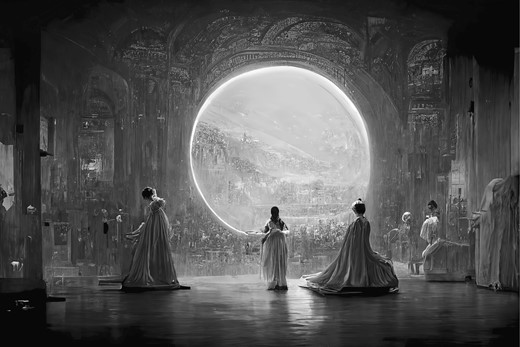
> Perhaps Allen was guilty of what Dennis Dutton (1979) would refer to as—in the context of discussing artistic forgeries—a *misrepresentation of achievement*: Allen presented the work as though it were the result of his own craft, the painstaking application of (digital) paint to canvas, whereas it was instead the result of his feeding textual prompts to an AI image generator. Such deception would be objectionable in the same way as forgeries are objectionable. However, it’s debatable whether Allen actually intended to mislead the judges in this way. In submitting the work, Allen signed the piece ‘Jason M Allen via Midjourney’. He never claimed that he had created the piece entirely on his own. He broke no competition rules in submitting an AI-generated image. And, finally, the judges agreed that, even if they had known that the piece had been generated using AI, they still would have awarded it first prize. ([View Highlight](https://read.readwise.io/read/01jqr4mbdf2hza0a893r13wt1m))
## New highlights added April 1, 2025 at 11:59 AM
> Present-day AI image generators such as Midjourney and DALL-E make use of a variety of sophisticated models for generating images, including generative adversarial networks (GANs) and diffusion models (Cetinic and She 2022). What is perhaps most notable about the current crop of tools is that they generate images from text inputs. This is the result of the application of ‘transformer-based architectures’ which, very briefly, work as follows: a text-encoder first encodes the text input prompt by mapping its contents to a multidimensional representational space, termed ‘latent space’. The tools have been pre-trained to link the encoded text prompt to similarly-abstracted image encodings; to map the encoding of, for example, ‘a green apple’ to abstract mappings of images featuring green apples. Finally, this image encoding is decoded into an image using either diffusion models or GANs to generate novel images that ‘fit’ the encoded data (Ramesh et al. 2021).1
> The effectiveness of these tools is the result of training them on massive datasets of image-text pairs. This training allows the tools to create the latent space mappings between encoded text and encoded images discussed above. Previously such datasets were often custom prepared for AI training—a costly and time-consuming process. The ImageNet database, for example, contains over 15 million images organized around thousands of hierarchically categorized words and concepts, all reviewed and quality-controlled by human input. Assembling this database has taken more than a decade of work completed by undergraduates and paid workers on Amazon’s Mechanical Turk platform (Fei-Fei and Krishna 2022). Unlike previous models, the current crop of AI image-generation tools relies on training data gathered directly from the internet without human input. For example, DALL-E relies on OpenAI’s CLIP model (Contrastive Language-Image Pre-training). CLIP scrapes text-image pairs from image captions and alt-text online, which has resulted in a mapping tool trained on hundreds of millions of image-text pairs, dramatically increasing its performance (Radford et al. 2021).
> To use these platforms to create new images, the user begins by typing in a string of text. After some delay, the user is then presented with several variations of the AI’s output. The user can then adjust the initial string, generating new outputs, or instead select one of the initial outputs to use to generate further variations. By way of this iterative process, the user can then attempt to zero in on a final image. What is perhaps most striking about the process is its *ease*: it is possible to create hundreds of images quite quickly. This often facilitates a sort of playful exploration and generation. Users are encouraged to iterate multiple times to see what the algorithm generates, exploring the effects of slight alterations to the prompt. By his own account, Jason Allen spent hours developing and refining the prompt he used to generate *Théâtre D’opéra Spatial*—a prompt that he considers to be central to his work, and which he has to this point declined to share with the public. ([View Highlight](https://read.readwise.io/read/01jqr55nbz5rc6ew28ppf2crc8))
> The production paradigm is often motivated by way of analogy. First, consider cases in which artists make use of a technological *tool* to realize particular artistic products. Perhaps the most natural starting point in the context of thinking about AI art would be photography. A photographer uses her camera equipment to realize a particular kind of image. In principle, the photographer might realize the image through other means—by, say, creating a photorealistic drawing of the scene in question. But in this case, she creates an image indirectly, allowing what Henry Fox Talbot called the ‘pencil of nature’ to capture the scene for her. Alternatively, consider a musician making use of a modular synthesizer to create a piece of music. By adjusting knobs and patching cables, she makes use of the synthesizer as a tool to create particular kinds of sounds that will feature in her composition. In each of these cases, the artist’s creative agency guides a process oriented towards the production of an artistic output—a photograph or a musical performance—that incorporates the use of a tool. ([View Highlight](https://read.readwise.io/read/01jqr58jzjtp1jdk4cespmd8x5))
> the *exploration* paradigm. According to this paradigm, artists primarily interact with generative AI as a means of exploring and interrogating the way that the generative AI platform ‘sees’ and ‘represents’. ([View Highlight](https://read.readwise.io/read/01jqr5fp064qp53ar3b4j8wmb2))
> Most of the current AI Art works can be understood as results of sampling the “latent space.” Perhaps the most novel aspect of AI Art is this possibility to venture into that abstract multi-dimensional space of encoded image representations …. How one orchestrates the design of this space and what one finds in it, eventually becomes the major task and distinctive “signature” of the artist. In this context, it is important to understand the role of the human in this collaborative process with the machine.
> (Cetinic and She 2022: 12) ([View Highlight](https://read.readwise.io/read/01jqr5gqcv253hr9fazhr4s5y1))
> Consider, by way of analogy, one of the most well-known examples of performance art: Marina Abramović’s *Rhythm 0* (1974). The piece, initially performed in Naples in 1974, consisted of a set of objects placed on a table—ranging from flowers, wine, and bread, to a gun, blades, and construction tools—along with a set of instructions provided to the audience. Roughly, the audience was instructed to use the objects on the table on Abramović herself in any way desired, and the artist claimed full responsibility for any outcome of this process over the six hours of the performance. The outcome of the process was rather horrific. According to Abramović’s own account, what began as mild interaction soon turned to attempted humiliation and assault as the audience removed her clothes, marked her body, cut her, and ultimately threatened her life (O’Hagan 2010). While it isn’t my aim here to offer a nuanced interpretation of the piece, I think one doesn’t have to reach far to see what Abramović’s general aims were: by structuring her interaction with her audience through provided objects and instructions, she aimed to elicit particular sorts of participation from them. It was the participation itself that would illuminate issues of collective responsibility, susceptibility to suggestion and instruction, and the perceived division between art and life. ([View Highlight](https://read.readwise.io/read/01jqr5mh9vzknfem452tev9hhd))
> My suggestion is that many AI artists approach their interaction with generative AI in the same manner. By way of their selection of prompts, they elicit a sort of ‘participation’ on the part of the AI in generating images. This participation allows them to interrogate the algorithm’s latent space (the abstract model allowing for the mapping of text strings to images). Why might such an interrogation of the latent space of the algorithm be significant? Alternatively, why should we care about the way that the algorithm ‘sees?’ Recall how these image generators are trained. They are the result of deep learning algorithms applied to a massive corpus of image-text pairs sourced from the internet. When we learn about the algorithm’s ways of seeing and representing, we are in some sense learning about *our own* ways of seeing and representing. We see ourselves through a glass darkly, as expressed in the visual culture of the internet and encoded by the algorithm’s deep learning. ([View Highlight](https://read.readwise.io/read/01jqr5mjft3gda83rtxg8eabrt))
> Let me illustrate with two examples. Sofia Crespo is an artist using AI to interrogate our visual representation of the natural world. *Critically Extant* (2022) is a series of works in which she uses an AI image generator to create representations of endangered or extinct species. Even though these image generators are trained on millions of publicly available images on the internet, the generated representations look very little like the species themselves. Consider the example of the Taurus Gudgeon, a small freshwater fish native to Turkey which the International Union for the Conservation of Nature lists as ‘critically endangered’. Crespo’s image of the fish doesn’t even look like a fish, let alone *this specific species* of fish. What accounts for this is the near-total absence of images and representations of these species in our ordinary online spaces. In mapping the blind spots of the algorithm, Crespo is able to illustrate how we collectively see—or more to the point, fail to see—these endangered species. ([View Highlight](https://read.readwise.io/read/01jqr5qakfrrmx5cjftkfrtp4h))
> According to the exploration paradigm, the AI artist contributes something similar by way of their prompts to the generative AI model: they create a space for the AI to participate in ways that may be challenging, illuminating, or engaging. ([View Highlight](https://read.readwise.io/read/01jqr60b208rn9t0a21re637gc))
> One question that may arise under the exploration model is whether or how the AI artist’s activity differs from, for example, AI content moderators who are often in the business of exploring AI models as well. What distinguishes the AI artist’s work as art?2 I don’t want to fully commit myself to any particular account of what makes an activity an artistic activity, but for the sake of argument I’ll adopt one approach that I think is promising: Richard Wollheim’s account of the importance of thematizing activities in his discussion of painting as an art. On Wollheim’s account, an artist thematizes their activity when they come to regard it as contributing in some way to the overall meaning of the artwork. According to Wollheim, it is in this process of thematization—of ‘attempt[ing] to organize an inherently inert material so that it will become serviceable for the carriage of meaning’—that a painter comes to practice painting as an art, rather than mere painting (1987: 20–25). Wollheim’s account is hardly uncontroversial, but I think his notion of thematization is useful here: artmaking requires a kind of critical engagement with one’s agency, especially insofar as it contributes to the meaning of the resultant work as a whole. I think this might help to clarify the difference between the AI artist and the AI content moderator. While the former aims to explore AI models for the sake of, for example, ensuring that these models are safe to use, the AI artist instead treats this exploration as a vehicle for artistic meaning. As I’ve illustrated by way of the examples above, many AI artists are interested in using AI as a kind of mirror in which we might explore ourselves, at least insofar as we are reflected in the model’s training data. This is one among many ways in which an AI artist might thematize their exploration of AI algorithms. ([View Highlight](https://read.readwise.io/read/01jqr62jms5mb25vnf46yd09nd))
> One option at this point would be to think of AI image generators not as a participant but rather as a very specific kind of tool—one that we use, perhaps, to explore our reflection in latent space. This approach might capture some of the motivation for the exploration paradigm without having to attribute participation to an AI model. However, I think that this approach would still face the concern that the opacity of these algorithms makes the analogy with tools imperfect as well. None of these analogies is perfect—a point I discuss in more detail in the conclusion below—but even so I believe that the exploration paradigm provides us with useful tools for understanding and appreciating AI art. ([View Highlight](https://read.readwise.io/read/01jqr64s27tn0vhxa7c8rz5k1x))
> A second, related question concerns the audience for AI art according to the exploration paradigm. In traditional performance art, the art is performed for an audience that, in addition to participating in the work, is also capable of experiencing the work. Unlike such an audience, an AI model seems incapable of experiencing a work. This question again points to the limits of the analogy with performance art, but in response, I will simply observe that performance art is often meant to be appreciated by an audience that extends well beyond those present at the initial performance. To return once more to the example of Abramović, audiences today appreciate her work by way of encountering documentation of it, such as photographs, recordings, and the physical objects that played a role in the performance. Similarly, I’d suggested that audiences can appreciate AI art by way of accessing the outputs of the artist’s exploration of the algorithm, that is, the images and other artefacts generated. These function as a kind of documentation enabling appreciation, even if they are not themselves the primary focus of artistic appreciation. ([View Highlight](https://read.readwise.io/read/01jqr65bhncy6gmjp1knypza4p))
> Even so, this is not mere categorization for its own sake. I suspect that the default approach to the appreciation and creation of AI art will be something akin to what I’ve called the production paradigm. This may result in a limited appreciation of the significance of AI art, insofar as we neglect important aspects of this art’s artistic value. Similarly, I suspect that AI artists themselves might find that adopting the exploration paradigm offers richer prospects for artmaking. In offering the exploration paradigm, my aim is to open up a sense of the possibility and promise of AI artmaking that goes beyond an exclusive focus on the objects that are the output of the creative process. ([View Highlight](https://read.readwise.io/read/01jqr6z302tra5gyeqb4wd16ef))
> In discussing artistic style, I first want to distinguish between two senses of the term: *general* style and *individual* style (Wollheim 1987: 26). In speaking of a general style, we might look to distinctive characteristics or notable features common to a body of work. Think here of the characteristic features of Art Nouveau, Brutalism, Impressionism, and the like. On the other hand, individual style is usually held to be a characteristic mode of agency present in the work of an individual artist, for example, a particular choice of technique, a specific set of artistic resources, and so on, which perhaps express the artist’s ideals for their work (Riggle 2015). Developing a style depends on the ability to reflect on one’s agency over time, to conceptualize it, and to consistently deploy it in artmaking with predictable results. ([View Highlight](https://read.readwise.io/read/01jqr71hj7mxb00y2v382cj0se))
- Note: That last sentence just seems wrong.
> As AI systems increasingly succeed in producing works that resemble the human works that they are trained to replicate, they will cease to produce weird outputs. As aestheticians, this might be of concern to us; soon, the distinctive aesthetic of weird AI art may be lost. ([View Highlight](https://read.readwise.io/read/01jqr72xjgbx6w1ah466edq8st))
> The exploration paradigm points us in a different direction in looking for style. The suggestion introduced above is that such style would lie in ‘how one orchestrates the design of [the latent space of encoded image representations] and what one finds in it’ (Cetinic and She 2022). Such a style would exist at the level of the prompts one chooses to explore, the choice of image-generation tool, and the like. It would not necessarily be discernible at the level of the visual outputs of one’s work, that is, the generated images. There are two important implications here. First, individual style for AI artists, should it exist, has less in common with the artistic style of traditional visual artists than we might have thought. Individual style for AI artists might instead be closer to the individual style of conceptual artists whose work includes a visual component, like Sol Lewitt or John Baldessari. Second, in looking for a general style of AI art we might do better to focus on nonvisual commonalities among work. We should focus instead on artists’ choices of AI models, prompting strategies, training data, and so on. Looking at AI art from the perspective of the exploration paradigm helps to make these points clearer, and I believe that doing so will lead to richer ways of conceptualizing and appreciating AI art. ([View Highlight](https://read.readwise.io/read/01jqr74gg8588t32rc247x2hfp))
> What is less appreciated is that, in the case of AI image generation, such bias may also be *aesthetically* objectionable. What I mean by this is that such bias might lead to significant concerns about the aesthetic value of the outputs of AI image-generation tools. Why might this be the case? Given that the current crop of tools has been trained on image-text mappings scraped from the internet, they are *very good* at producing conventional modes of representing particular objects. This is true quite generally, but also at the level of general visual styles of the sort discussed above: you can get an ordinary picture of a hot dog, and you can also generate a hot-dog picture in the style of Van Gogh, film noir, cyberpunk, or clipart. But you cannot use these tools to generate a new mode of representation or a new visual style entirely. The concern is that these algorithms are therefore ‘locked in’ to established modes of representation. The worry, then, is that AI-generated art cannot be original. ([View Highlight](https://read.readwise.io/read/01jqr76c6vjg5jxkj83r13td1x))