# Visual Metaphors and Cognition: Revisiting the Non-Conceptual
## Metadata
- Author: [[Michalle Gal]]
- Full Title: Visual Metaphors and Cognition: Revisiting the Non-Conceptual
- Category: #articles
- Summary: insert summary
- My notes:
- Summary: Visual metaphors are essential in understanding complex concepts through visual representations, challenging traditional linguistic and conceptual definitions of metaphor. The visual aspect of metaphors plays a crucial role in how we perceive and interpret them, emphasizing the importance of visuality over conceptual understanding. By focusing on the visual essence of metaphors, we can appreciate their aesthetic and intellectual value beyond linguistic structures.
- URL: https://readwise.io/reader/document_raw_content/194137205
- Source File: Visual Metaphors and Cognition 2019 by Gal.pdf
## LLM Chats
## NotebookLM
## LLM Audio
## Highlights
> Visual Metaphors and Cognition: Revisiting the Non-Conceptual ([View Highlight](https://read.readwise.io/read/01j2xy0yaw8vvaraxdnqdc14ph))
> I think the visual is the paradigmatic kind of metaphor, rather than the concep- tual or the linguistic ones. ([View Highlight](https://read.readwise.io/read/01j2ttcdyx8906f9xcxkf2h43t))
> . Lakoff and Johnson, as is well-known, offer a conceptual-cognitivist theory of metaphor, claiming that metaphor does not merely originate in the conceptual mind, but is also conceptual through and through. They do use the term “structure” to describe the metaphorical faculty. For example, when analyzing ARGUMENT IS WAR, which they label a “conceptual metaphor”, they argue that “we don’t just talk about arguments in terms of war. We can actually win or lose arguments. … Many of the things we do in arguing are partially structured by the concept of war.”2 Regarding THEORIES ARE BUILDINGS, they claim: “The parts of the concept BUILDING that are used to structure the concept THE- ORY are the foundation and the outer shell.”3 However, for Lakoff and Johnson, the metaphor itself dwells in the cognitive epistemo- logical stratum and is merely reflected in our literal language or ex- perience or reality. They define metaphor as “understanding and ex- periencing one kind of thing in terms of another”, rather than as a linguistic unit, let alone a visual or a material one. ([View Highlight](https://read.readwise.io/read/01j2tteh9gc4d11rgys9cs7mmg))
> What en- ables us to understand one concept in terms of another is the com- positions and structural possibilities that the visual sphere offers us: the visuality of buildings whose properties are applied to theories. ([View Highlight](https://read.readwise.io/read/01j2ttfh8n2pk913xtdqc553dw))
> “the human con- ceptual system is metaphorically structured” as well as that “our con- cepts structure what we perceive, how we get around in the world.”4 The first use unexpectedly implies that there is some epistemological stratum which precedes the conceptual system. ([View Highlight](https://read.readwise.io/read/01j2ttrc7x3qydyvfrr8r3hseb))
> not only is it the case that metaphors are not founded on an internal conceptual system, but it also holds that what renders the ([View Highlight](https://read.readwise.io/read/01j2tttt1xkvr83sxw685h0yfq))
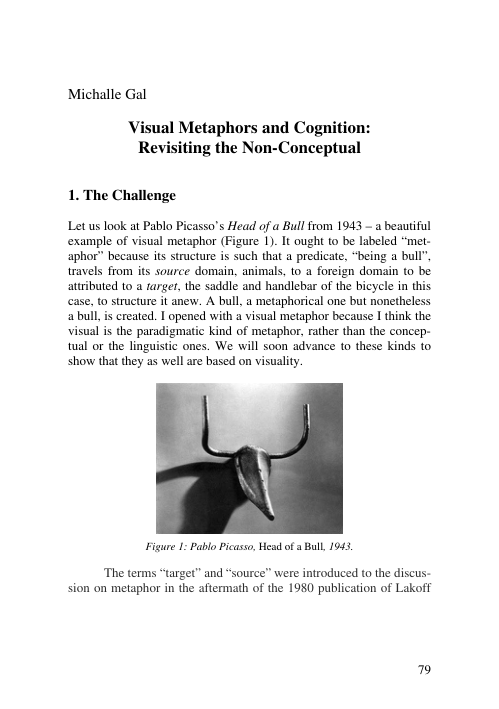
> bicycle parts a bull’s head (source) in Picasso’s visual metaphor cannot be captured conceptually. It is a composition. ([View Highlight](https://read.readwise.io/read/01j2tttyjqpd15tw5vst62bwvx))
> It is the way in which the saddle and the handlebar, the target of the metaphor, are positioned, as well as their interrelations. Moreover, this composition is endowed with what Nelson Goodman accurately named “syntactic density” or “repleteness” to characterize the function of “aesthetic symbols” – where every single feature of the symbol counts: posi- tion, line, thickness, shape, etc.5 In my view, repleteness and density are the aesthetic sub-categories of the general fine-grainedness of the experienced reality and its representational content. Peacocke asserts that those are beyond conceptual content. ([View Highlight](https://read.readwise.io/read/01j2ttw5y36z701k5w14x7983f))
> This dialectical attribution of a predicate, this dialectical construction which is accompanied with the viewer’s aesthetic experience, cannot be fully conceptualized as long as the metaphor is alive. My very at- tempt to literally describe it here is actually harmful, since it forces linguistic or conceptual order on the visual, freezes the non-concep- tual living and productive visual metaphor into conceptuality and turns it into a dead metaphor at most. ([View Highlight](https://read.readwise.io/read/01j2tw9jfcfykn53zx1qw362d8))
> Analyzing this visual aspect of metaphors, I propose a theory of met- aphor that characterizes visuality as its essence. Metaphorical struc- turing, creating or transfiguring, as well as metaphorical conceiving or understanding one thing as another, is a visual ability. Metaphor- ical mechanism is a predication – assigning a predicate to an object – by means of producing nonconventional structures or compositions, namely, by compositional, or even aesthetic, means. ([View Highlight](https://read.readwise.io/read/01j2twf3nrrfzjvfak13n1ts36))
> Oldenburg’s ([View Highlight](https://read.readwise.io/read/01j2y2afetxw73dgcskb5bxpc8))
> French Fries and Ketchup or Giant Soft Drum ([View Highlight](https://read.readwise.io/read/01j2y29ey8gbnnqh6w93ywmvt9))
> Baboon and Young and Head of a Bull combine two compo- nents originating in different categories to one entity. Oldenburg’s French Fries and Ketchup or Giant Soft Drum Set do not combine entities, but themes, dimensions, and materials. The car (target) is a baboon’s head (source), and it sometimes works symmetrically as well: the head is a car. The fries are enormous and made of vinyl; the drums are cushion. These structures enhance the categories of ba- boons, of fries, and of drums and cushions, as well as the extensions of the predicates. ([View Highlight](https://read.readwise.io/read/01j2y24sasf2ey5cfmqvnest6z))
> he asks if visual metaphors are actually linguistic metaphors dressed in visuality. My answer is that it is the other way around. Verbal metaphor gains its metaphorical trait by its structure and its syntactic density. ([View Highlight](https://read.readwise.io/read/01j2twnw7em2zdy5jnzd3ac23x))
> Defining the visuality of metaphors as their essence, we may accept that visual metaphors are the paradigmatic ones, whose mech- anism is shared by the various kinds of metaphors. Metaphorical mechanism is based on aptness of form, configuration, syntactic ar- rangement, or material composition, rather than on understanding one thing through another. ([View Highlight](https://read.readwise.io/read/01j2y4esrg4q7hpm3k981yp479))
> Accordingly, metaphor is the aesthetic layer of ordinary language – the intersection in which language meets art. Metaphors paradigmatically comprise the rela- tionship between the visual realm and ordinary language, or more specifically between images and texts. ([View Highlight](https://read.readwise.io/read/01j2tws82y5r6eb6n46bn7361f))