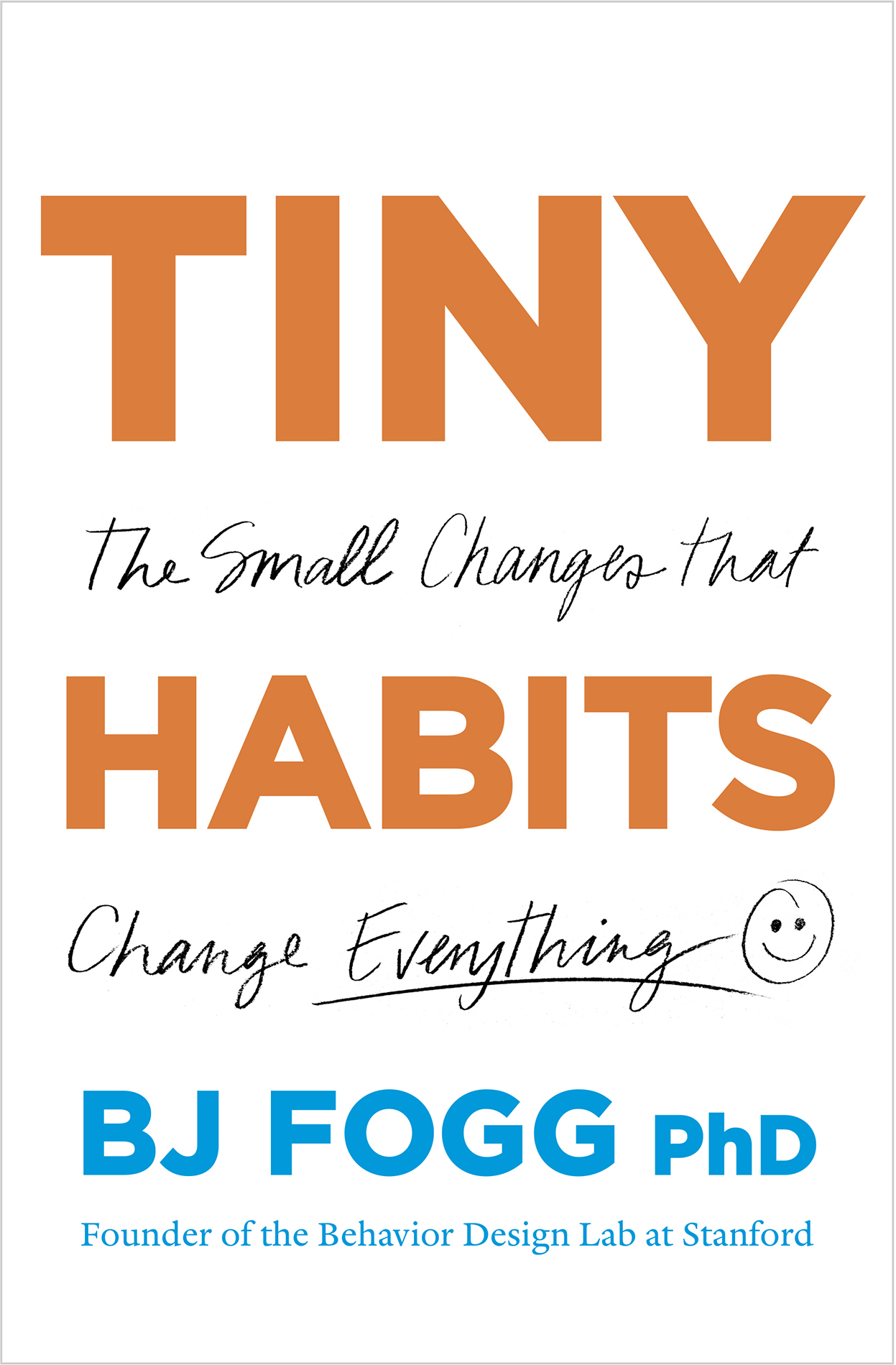
# Tiny Habits
## Metadata
- Author: [[BJ Fogg]]
- Full Title: Tiny Habits
- Category: #books
- Summary: insert summary
- My notes:
- Summary: The Tiny Habits method helps people create positive changes in their lives by starting with small, manageable habits. By choosing simple behaviors and pairing them with prompts, individuals can build confidence and develop more habits over time. This approach not only benefits the individual but also positively impacts their families and communities.
## LLM Chats
## NotebookLM
## LLM Audio
## Highlights
> On a work trip to Ghana, Juni (whose sweet tooth was legendary) went looking for a place to buy ice cream at seven a.m. After reminding her that she was in West Africa, her colleagues asked why on earth she wanted ice cream for breakfast.
> “Because I’m a grown woman, and I can eat whatever I want,” she replied.
> When Juni tells that story now, she shakes her head in disbelief. How could it have taken so long to recognize what was really going on? It wasn’t just ice cream for breakfast, it was a double caramel macchiato for lunch, an onion-flavored corn snack (Funyuns!) for commercial breaks, and more ice cream for dinner — separate behaviors that were an intricate part of her day that amounted to a big problem for her health and happiness.
> Juni’s denial about the extent of her sugar habit is surprising to her in retrospect, but at the time, she was focused on other things and was incredibly disciplined in almost every other part of her life. In addition to being a successful radio host, she was an avid runner. In fact, she first signed up for Tiny Habits because her goal was to run the Chicago Marathon. During her initial sessions, Juni created a handful of new habits to help strengthen her core to improve her running times. Those new Tiny Habits went so well that she started creating other habits related to productivity at work, and she even adopted some healthy eating measures that kept some of her sugar pangs at bay.
> But then her mom died in 2015.
> A focused, get-’er-done kind of woman like her daughter, June died of complications directly related to diabetes. Juni flew to Alabama to help her oldest sister make all the final arrangements. Her six siblings — the youngest was just nineteen — were devastated and leaned heavily on Juni. Despite the stress and her own profound sadness, Juni tried to be strong for them, but that took its toll. So when her husband asked what she needed when she got home, Juni didn’t hesitate. “I need bubblegum ice cream from Baskin-Robbins.”
> Two years later and fifteen pounds heavier, Juni realized her unresolved grief, was surging. After her mother’s funeral, Juni jumped right back into her busy life. Two kids, a job, a marriage. The needs of her eleven-year-old autistic son seemed to grow in tandem with her rising stress levels. Looking back on it, Juni realizes that the loss of her mother was always in the background as she charged forward and made it through each day at any cost. Instead of confronting her sadness, Juni fed her grief cookie-dough ice cream and cake, which only made the inevitable sugar crash twice as painful.
> Sugar eventually started to impede on her life in ways that even Juni could no longer deny. Carrying the extra weight made running harder, and she felt jittery and foggy at work. As a radio talk show personality, she had to be able to riff on responses to questions and field surprise callers who had something wacky to say. In the midst of a sugar high, she was energized, but she also felt scattered and unable to focus.
> Juni joined my Behavior Design Boot Camp hoping for professional insights she could share with her team, but she came away realizing that she could apply all of the techniques to her own well-being. Reinvigorated, Juni covered the walls of her office at home with paper and got out the markers. She identified an aspiration for every area of her life, then did a Swarm of Behaviors, then Focus Mapped the heck out of it all. In the last blank space, Juni wrote stop eating sugar and circled it. She stepped back and drew in a deep breath.
> This was it.
> This was the most important transformative behavior she could do. But it was something she would have to design *out* of her life. She got a little tingle on the back of her neck and knew that this was the hardest race she’d ever signed up for.
> The only snag in her plan was that the boot camp and Tiny Habits hadn’t focused on *breaking* a bad habit; she’d learned only how to create new ones. But because Juni was nothing if not disciplined, smart, and bold, she figured she could use the Behavior Model to reverse engineer these behaviors out of her life.
> So that’s what she did.
> She put specific sugar-eating habits — “I eat ice cream every night for dinner” — on the Behavior Model and figured out the mechanics of motivation, ability, and prompt that were causing her to surge over the Action Line. She realized that fatigue and grief were prompting her to eat sugar. Juni was also using sugar to help keep herself on her toes. And then she would miss her mom, which always seemed to prompt a binge.
> To tackle the sugar monster, Juni tried ridding her house of sugary snacks. She tried ignoring her fatigue or replacing ice cream with pretzels, and she stocked her car with an emergency stash of sugar-free snack bars. When she got sad about her mom, Juni would play Pokémon Go instead of eating.
> What ultimately worked for Juni was addressing her grief prompt at its root. She first created a handful of positive habits — journaling and reaching out to friends through social media — which helped her mourn her mother in a way that processed the grief instead of suppressing it. The more she dealt with her grief in a healthy way, the better she felt, and her motivation to do her positive habits became stronger. As Juni started to increase the time between sugary snacks, she saw opportunities for celebrating those small successes. Juni could go one meal without eating sugar at first. Then she could go a couple of hours. This might not seem like much, but Juni knew that she had to lower her expectations. And those moments felt like victories to her.
> Knowing the importance of harnessing the feeling of success, Juni celebrated when she went one day without sugar. A huge milestone. Even though she wasn’t always perfect, she continued on this path until she completed an entire week without eating any sugary snacks.
> Juni knew the importance of being flexible and iterative, and she experimented with dozens of new habits. She was challenged by special occasions where sugar was everywhere, and if she occasionally succumbed to the siren call of cookie-dough ice cream, she wasn’t too hard on herself — she looked at it as a challenge to study and hack. She came up with work-arounds for moments of vulnerability, and through trial and error, she discovered what worked and what didn’t while she remained compassionate with herself and celebrated her wins.
> These wins compounded quickly, and Juni’s multipronged approach started to pay off and made her feel as if she could choose to eat sugar or not. Her addiction had held her hostage, and now she knew she could change that. Juni had completed Behavior Design Boot Camp in March. At the end of May, she sent me an e-mail telling me that she had done it.
> Juni had beaten sugar.
> When Juni told me that she had stopped her sugar habit using the skills learned through Behavior Design and Tiny Habits, I was proud of her, and it inspired me to share my methods on stopping bad habits more widely. I had found success stopping my own bad habits throughout the years, but I had kept my focus on helping people create new positive habits. I was also hesitant to wade into the territory of bad habits too deeply because I am not an addiction specialist, and conversations about bad habits often quickly turn to substance abuse and compulsive behaviors. I didn’t want to take on the role of a therapist or a medical doctor. I knew that Tiny Habits is not the answer to serious addictions. But for people with bad habits that are not serious addictions, I have good news: Tiny Habits can be game changing.
> A helpful way to think about habits is to put them into three categories. I’m talking about *all* habits here — good and bad. Uphill Habits are those that require ongoing attention to maintain but are easy to stop — getting out of bed when your alarm goes off, going to the gym, or meditating daily.
> Downhill Habits are easy to maintain but difficult to stop — hitting snooze, swearing, watching YouTube.
> Freefall Habits are those habits like substance abuse that can be extremely difficult to stop unless you have a safety ([View Highlight](https://read.readwise.io/read/01j7h656e7s40ztcg7e4dkxqpk))